use a graphing calculator to graph the function. identify the x - intercepts and the points where the local…
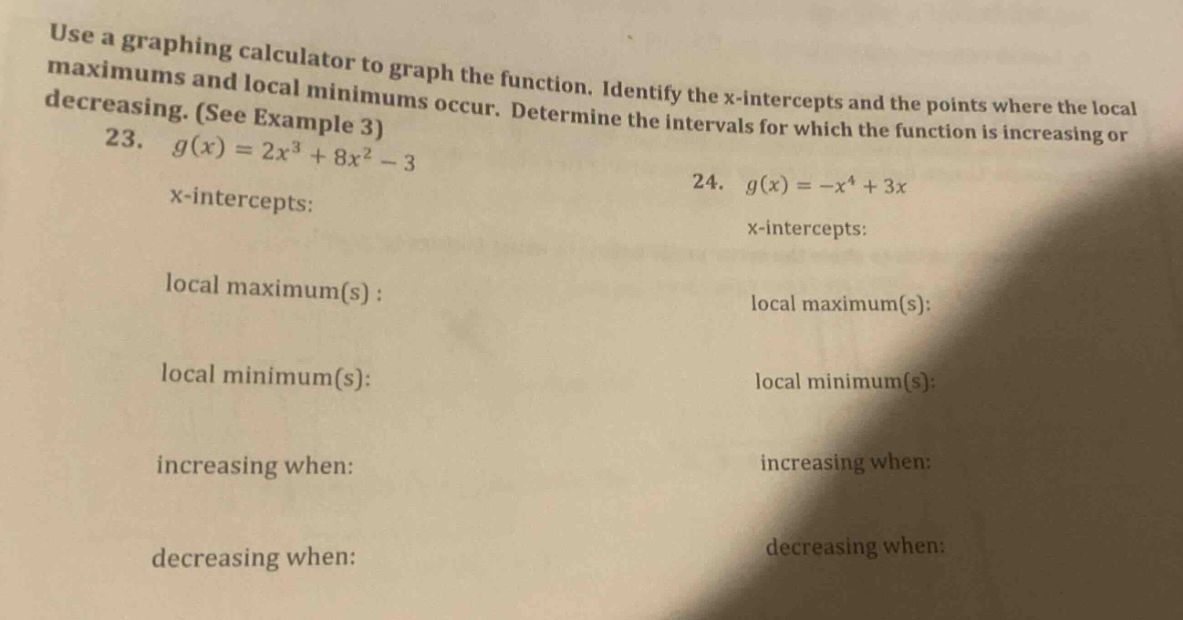
use a graphing calculator to graph the function. identify the x - intercepts and the points where the local maximums and local minimums occur. determine the intervals for which the function is increasing or decreasing. (see example 3) 23. g(x)=2x³ + 8x² - 3 x - intercepts: local maximum(s): local minimum(s): increasing when: decreasing when: 24. g(x)=-x⁴ + 3x x - intercepts: local maximum(s): local minimum(s): increasing when: decreasing when:
Answer
Explanation:
Step1: Find the derivative of $g(x)=2x^{3}+8x^{2}-3$
$g'(x)=6x^{2}+16x = 2x(3x + 8)$
Step2: Find the x - intercepts of $g(x)$
Set $g(x)=0$, $2x^{3}+8x^{2}-3 = 0$. Using a graphing - calculator, the x - intercepts are approximately $x\approx - 3.97$, $x\approx0.59$.
Step3: Find the critical points
Set $g'(x)=0$, $2x(3x + 8)=0$. The critical points are $x = 0$ and $x=-\frac{8}{3}\approx - 2.67$.
Step4: Determine local maxima and minima
Use the second - derivative test. $g''(x)=12x + 16$. $g''(0)=16>0$, so $g(x)$ has a local minimum at $x = 0$, and $g(0)=-3$. $g''(-\frac{8}{3})=-16<0$, so $g(x)$ has a local maximum at $x =-\frac{8}{3}$, and $g(-\frac{8}{3})=2(-\frac{8}{3})^{3}+8(-\frac{8}{3})^{2}-3=\frac{256}{27}-3=\frac{256 - 81}{27}=\frac{175}{27}\approx6.48$.
Step5: Determine intervals of increase and decrease
Test intervals: For $x<-\frac{8}{3}$, let $x=-3$, $g'(-3)=2(-3)(3(-3)+8)=6>0$, so $g(x)$ is increasing on $(-\infty,-\frac{8}{3})$. For $-\frac{8}{3}<x<0$, let $x=-1$, $g'(-1)=2(-1)(3(-1)+8)=-10<0$, so $g(x)$ is decreasing on $(-\frac{8}{3},0)$. For $x>0$, let $x = 1$, $g'(1)=2(1)(3(1)+8)=22>0$, so $g(x)$ is increasing on $(0,\infty)$.
Answer:
x - intercepts: $x\approx - 3.97$, $x\approx0.59$ local maximum(s): $(-\frac{8}{3},\frac{175}{27})$ local minimum(s): $(0, - 3)$ increasing when: $x\in(-\infty,-\frac{8}{3})\cup(0,\infty)$ decreasing when: $x\in(-\frac{8}{3},0)$
For $g(x)=-x^{4}+3x$:
Explanation:
Step1: Find the derivative of $g(x)$
$g'(x)=-4x^{3}+3$
Step2: Find the x - intercepts of $g(x)$
Set $g(x)=0$, $-x^{4}+3x=x(-x^{3}+3)=0$. The x - intercepts are $x = 0$ and $x=\sqrt[3]{3}\approx1.44$.
Step3: Find the critical points
Set $g'(x)=0$, $-4x^{3}+3 = 0$, $x^{3}=\frac{3}{4}$, $x=\sqrt[3]{\frac{3}{4}}\approx0.90$.
Step4: Determine local maxima and minima
Use the second - derivative test. $g''(x)=-12x^{2}$. $g''(\sqrt[3]{\frac{3}{4}})=-12(\sqrt[3]{\frac{3}{4}})^{2}<0$, so $g(x)$ has a local maximum at $x=\sqrt[3]{\frac{3}{4}}$, and $g(\sqrt[3]{\frac{3}{4}})=-(\sqrt[3]{\frac{3}{4}})^{4}+3\sqrt[3]{\frac{3}{4}}=\frac{9}{4}\sqrt[3]{\frac{3}{4}}\approx1.65$.
Step5: Determine intervals of increase and decrease
Test intervals: For $x<\sqrt[3]{\frac{3}{4}}$, let $x = 0$, $g'(0)=3>0$, so $g(x)$ is increasing on $(-\infty,\sqrt[3]{\frac{3}{4}})$. For $x>\sqrt[3]{\frac{3}{4}}$, let $x = 1$, $g'(1)=-4 + 3=-1<0$, so $g(x)$ is decreasing on $(\sqrt[3]{\frac{3}{4}},\infty)$.
Answer:
x - intercepts: $x = 0$, $x=\sqrt[3]{3}$ local maximum(s): $(\sqrt[3]{\frac{3}{4}},\frac{9}{4}\sqrt[3]{\frac{3}{4}})$ local minimum(s): None increasing when: $x\in(-\infty,\sqrt[3]{\frac{3}{4}})$ decreasing when: $x\in(\sqrt[3]{\frac{3}{4}},\infty)$