use the graphing tool to determine the true statements regarding the represented function. check all that…
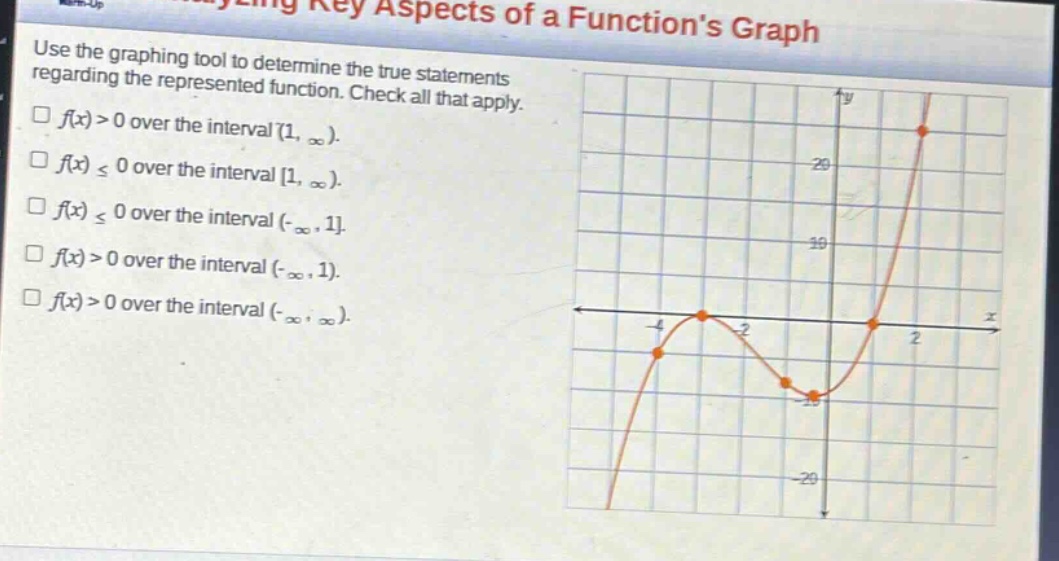
use the graphing tool to determine the true statements regarding the represented function. check all that apply.\n□ (f(x)>0) over the interval ((1,infty)).\n□ (f(x)leq0) over the interval (1,infty)).\n□ (f(x)leq0) over the interval ((-infty,1).\n□ (f(x)>0) over the interval ((-infty,1)).\n□ (f(x)>0) over the interval ((-infty,infty)).
Answer
Explanation:
Step1: Analyze the graph for $x > 1$
The graph is above the $x -$axis for $x>1$. So $f(x)>0$ over the interval $(1,\infty)$.
Step2: Analyze the graph for $x\geq1$
Since the graph is above the $x -$axis for $x > 1$ and at $x = 1$ it is not below the $x -$axis, the statement $f(x)\leq0$ over $[1,\infty)$ is false.
Step3: Analyze the graph for $x\leq1$
The graph is below the $x -$axis for some values of $x$ in the interval $(-\infty,1]$. So $f(x)\leq0$ over $(-\infty,1]$ is true.
Step4: Analyze the graph for $x<1$
The graph is not entirely above the $x -$axis for $x<1$, so $f(x)>0$ over $(-\infty,1)$ is false.
Step5: Analyze the graph for all real $x$
The graph is below the $x -$axis for some values, so $f(x)>0$ over $(-\infty,\infty)$ is false.
Answer:
$f(x)>0$ over the interval $(1,\infty)$; $f(x)\leq0$ over the interval $(-\infty,1]$