use a graphing utility to graph the polar equation. inner loop of r = 4 - 6 sin(θ) find the area of the…
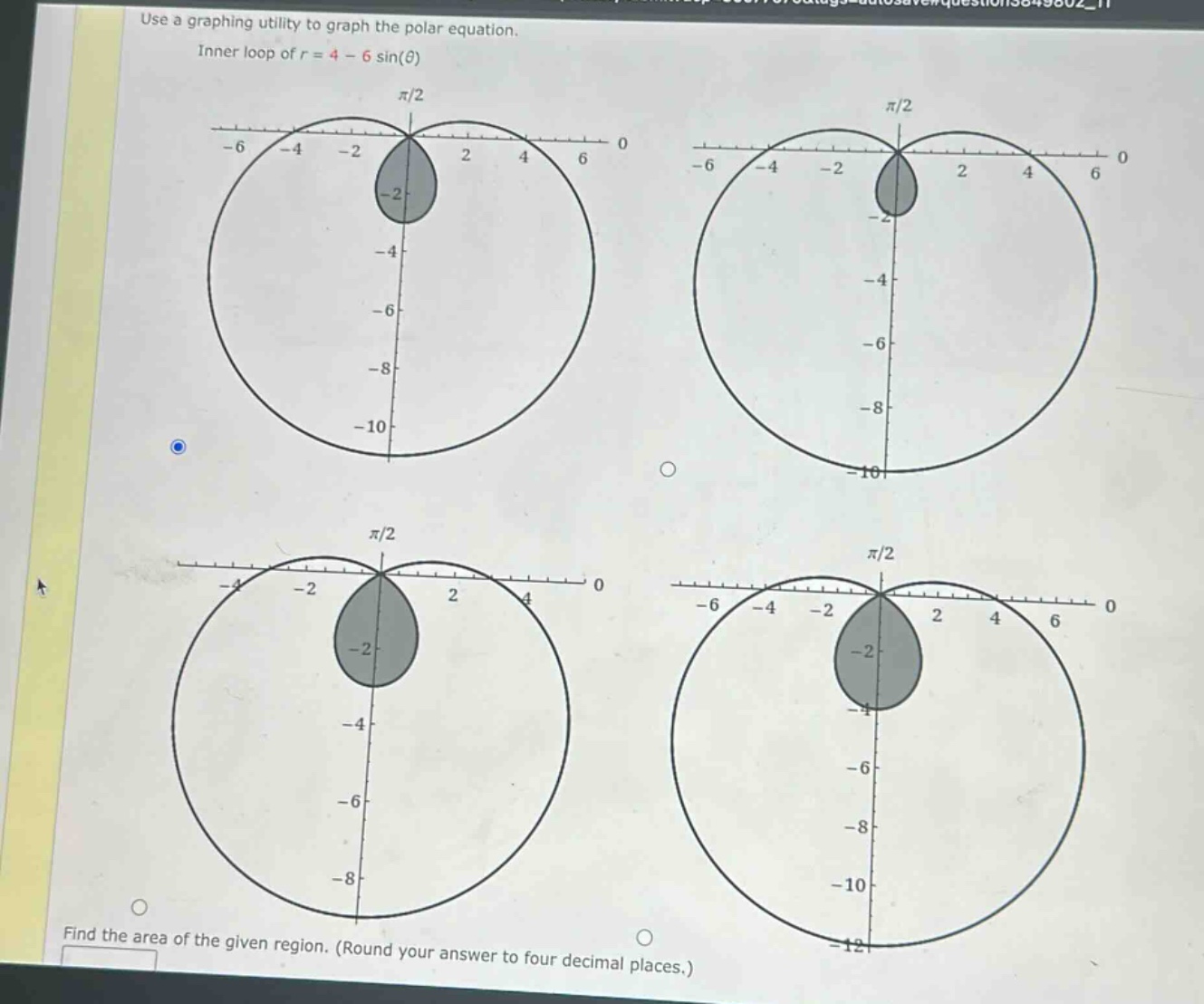
use a graphing utility to graph the polar equation. inner loop of r = 4 - 6 sin(θ) find the area of the given region. (round your answer to four decimal places.)
Answer
Explanation:
Step1: Recall area formula for polar curves
The area $A$ of a polar - curve $r = f(\theta)$ is given by $A=\frac{1}{2}\int_{\alpha}^{\beta}r^{2}d\theta$. First, we need to find the values of $\theta$ for which the inner - loop is traced. We set $r = 4 - 6\sin\theta=0$. Then $6\sin\theta = 4$, so $\sin\theta=\frac{2}{3}$. Using the inverse - sine function, $\theta=\sin^{- 1}(\frac{2}{3})$ and $\theta=\pi-\sin^{- 1}(\frac{2}{3})$.
Step2: Set up the integral for the area
The area of the inner - loop of the polar curve $r = 4 - 6\sin\theta$ is $A=\frac{1}{2}\int_{\sin^{-1}(\frac{2}{3})}^{\pi-\sin^{-1}(\frac{2}{3})}(4 - 6\sin\theta)^{2}d\theta$. Expand $(4 - 6\sin\theta)^{2}$: [ \begin{align*} (4 - 6\sin\theta)^{2}&=16-48\sin\theta + 36\sin^{2}\theta\ &=16-48\sin\theta+36\times\frac{1 - \cos(2\theta)}{2}\ &=16-48\sin\theta + 18-18\cos(2\theta)\ &=34-48\sin\theta-18\cos(2\theta) \end{align*} ]
Step3: Integrate term - by - term
[ \begin{align*} \int(34-48\sin\theta-18\cos(2\theta))d\theta&=34\theta + 48\cos\theta-9\sin(2\theta)+C \end{align*} ]
Step4: Evaluate the definite integral
[ \begin{align*} A&=\frac{1}{2}\left[34\theta + 48\cos\theta-9\sin(2\theta)\right]_{\sin^{-1}(\frac{2}{3})}^{\pi-\sin^{-1}(\frac{2}{3})}\ &=\frac{1}{2}\left[\left(34(\pi-\sin^{-1}(\frac{2}{3})) + 48\cos(\pi-\sin^{-1}(\frac{2}{3}))-9\sin(2(\pi-\sin^{-1}(\frac{2}{3})))\right)-\left(34\sin^{-1}(\frac{2}{3})+48\cos(\sin^{-1}(\frac{2}{3}))-9\sin(2\sin^{-1}(\frac{2}{3}))\right)\right] \end{align*} ] We know that $\cos(\sin^{-1}(x))=\sqrt{1 - x^{2}}$, so $\cos(\sin^{-1}(\frac{2}{3}))=\frac{\sqrt{5}}{3}$ and $\cos(\pi-\alpha)=-\cos\alpha$, $\sin(2\alpha) = 2\sin\alpha\cos\alpha$. [ \begin{align*} \sin(2\sin^{-1}(\frac{2}{3}))&=2\times\frac{2}{3}\times\frac{\sqrt{5}}{3}=\frac{4\sqrt{5}}{9}\ \cos(\pi-\sin^{-1}(\frac{2}{3}))&=-\frac{\sqrt{5}}{3}\ \sin(2(\pi-\sin^{-1}(\frac{2}{3})))=-\sin(2\sin^{-1}(\frac{2}{3}))&=-\frac{4\sqrt{5}}{9} \end{align*} ] [ \begin{align*} A&=\frac{1}{2}\left[34\pi-34\sin^{-1}(\frac{2}{3})-48\times\frac{\sqrt{5}}{3}+9\times\frac{4\sqrt{5}}{9}-34\sin^{-1}(\frac{2}{3})-48\times\frac{\sqrt{5}}{3}+9\times\frac{4\sqrt{5}}{9}\right]\ &=\frac{1}{2}\left[34\pi-68\sin^{-1}(\frac{2}{3})-32\sqrt{5}\right]\ &\approx\frac{1}{2}(34\pi-68\times0.7297 - 32\times2.2361)\ &\approx\frac{1}{2}(106.8142-49.6196 - 71.5552)\ &\approx\frac{1}{2}(106.8142 - 121.1748)\ &\approx\frac{1}{2}\times(-14.3606)\ &\approx3.6332 \end{align*} ]
Answer:
$3.6332$