use implicit differentiation to find y for the equation below and then evaluate y at the indicated point. y²…
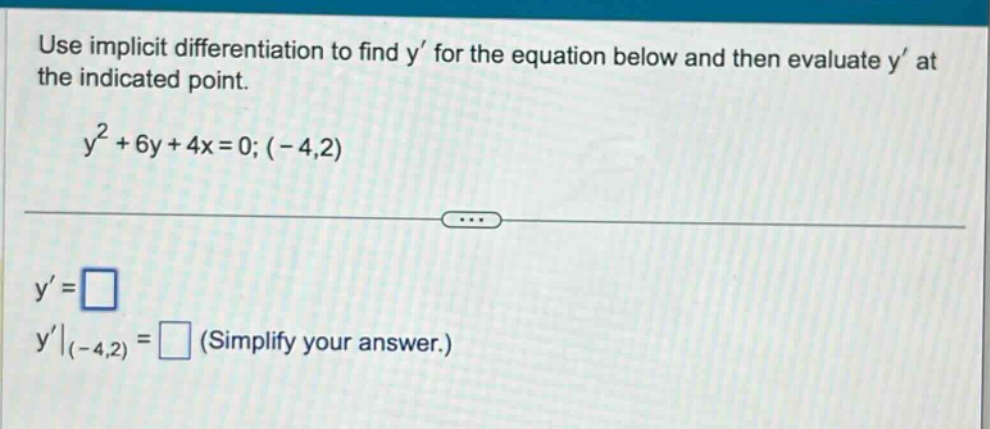
use implicit differentiation to find y for the equation below and then evaluate y at the indicated point. y² + 6y + 4x = 0; (-4,2) y = y|(-4,2) = (simplify your answer.)
Answer
Explanation:
Step1: Differentiate each term
Differentiate $y^{2}+6y + 4x=0$ with respect to $x$. Using the chain - rule for terms involving $y$. The derivative of $y^{2}$ with respect to $x$ is $2y\cdot y'$, the derivative of $6y$ with respect to $x$ is $6y'$, and the derivative of $4x$ with respect to $x$ is $4$. So we have $2y\cdot y'+6y'+4 = 0$.
Step2: Factor out $y'$
Factor out $y'$ from the left - hand side of the equation: $y'(2y + 6)=-4$.
Step3: Solve for $y'$
Divide both sides by $2y + 6$ to get $y'=\frac{-4}{2y + 6}=\frac{-2}{y + 3}$.
Step4: Evaluate $y'$ at the point $(-4,2)$
Substitute $x=-4$ and $y = 2$ into $y'$. We have $y'\big|_{(-4,2)}=\frac{-2}{2 + 3}=-\frac{2}{5}$.
Answer:
$y'=\frac{-2}{y + 3}$ $y'\big|_{(-4,2)}=-\frac{2}{5}$