use implicit differentiation to find y and then evaluate y at (1,1). x ln y + 3y = 3x^3 y = □ y|(1,1) = □…
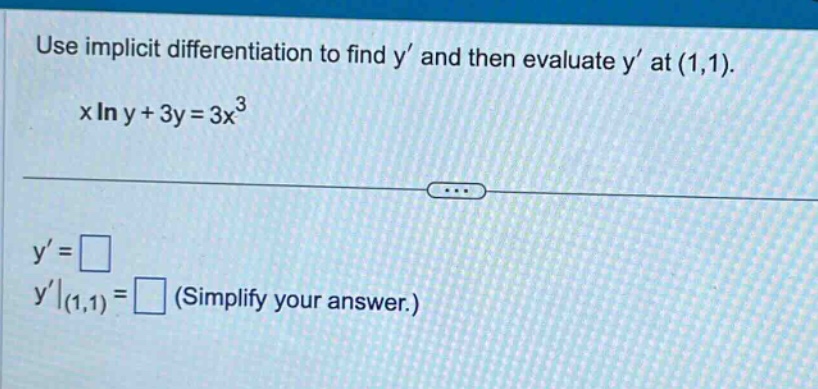
use implicit differentiation to find y and then evaluate y at (1,1). x ln y + 3y = 3x^3 y = □ y|(1,1) = □ (simplify your answer.)
Answer
Explanation:
Step1: Differentiate both sides
Differentiate $x\ln y + 3y=3x^{3}$ with respect to $x$. Using product - rule $(uv)^\prime = u^\prime v+uv^\prime$ on $x\ln y$ where $u = x$ and $v=\ln y$. The derivative of $x$ with respect to $x$ is $1$, and the derivative of $\ln y$ with respect to $x$ is $\frac{y^\prime}{y}$ by the chain - rule. The derivative of $3y$ with respect to $x$ is $3y^\prime$, and the derivative of $3x^{3}$ with respect to $x$ is $9x^{2}$. So, $1\times\ln y+x\times\frac{y^\prime}{y}+3y^\prime = 9x^{2}$.
Step2: Isolate $y^\prime$
$\ln y+\frac{xy^\prime}{y}+3y^\prime = 9x^{2}$. Factor out $y^\prime$: $y^\prime(\frac{x}{y}+3)=9x^{2}-\ln y$. $y^\prime=\frac{9x^{2}-\ln y}{\frac{x}{y}+3}=\frac{y(9x^{2}-\ln y)}{x + 3y}$.
Step3: Evaluate $y^\prime$ at $(1,1)$
Substitute $x = 1$ and $y = 1$ into $y^\prime$. $y^\prime|{(1,1)}=\frac{1\times(9\times1^{2}-\ln1)}{1 + 3\times1}$. Since $\ln1 = 0$, then $y^\prime|{(1,1)}=\frac{9-0}{1 + 3}=\frac{9}{4}$.
Answer:
$y^\prime=\frac{y(9x^{2}-\ln y)}{x + 3y}$ $y^\prime|_{(1,1)}=\frac{9}{4}$