use implicit differentiation to find z’ and then evaluate z’ at (3, - 5). xz + 15 = 0 z’ = z’|(3, - 5) =…
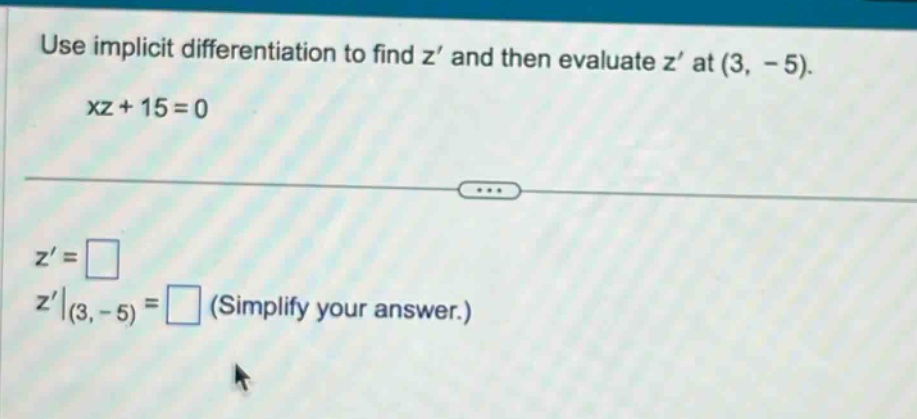
use implicit differentiation to find z’ and then evaluate z’ at (3, - 5). xz + 15 = 0 z’ = z’|(3, - 5) = (simplify your answer.)
Answer
Explanation:
Step1: Differentiate both sides
Differentiate $xz + 15=0$ with respect to $x$. Using the product - rule $(uv)^\prime = u^\prime v+uv^\prime$ where $u = x$ and $v = z$. The derivative of $x$ with respect to $x$ is $1$, and the derivative of $z$ with respect to $x$ is $z^\prime$. The derivative of a constant ($15$) is $0$. So we have: $1\times z+x\times z^\prime+0 = 0$ $z + xz^\prime=0$
Step2: Solve for $z^\prime$
Isolate $z^\prime$ in the equation $z + xz^\prime=0$. $xz^\prime=-z$ $z^\prime=-\frac{z}{x}$
Step3: Evaluate $z^\prime$ at $(3,-5)$
Substitute $x = 3$ and $z=-5$ into $z^\prime$. $z^\prime|_{(3,-5)}=-\frac{-5}{3}=\frac{5}{3}$
Answer:
$z^\prime=-\frac{z}{x}$ $z^\prime|_{(3,-5)}=\frac{5}{3}$