use the integral test to determine whether the series shown below converges or diverges. be sure to check…
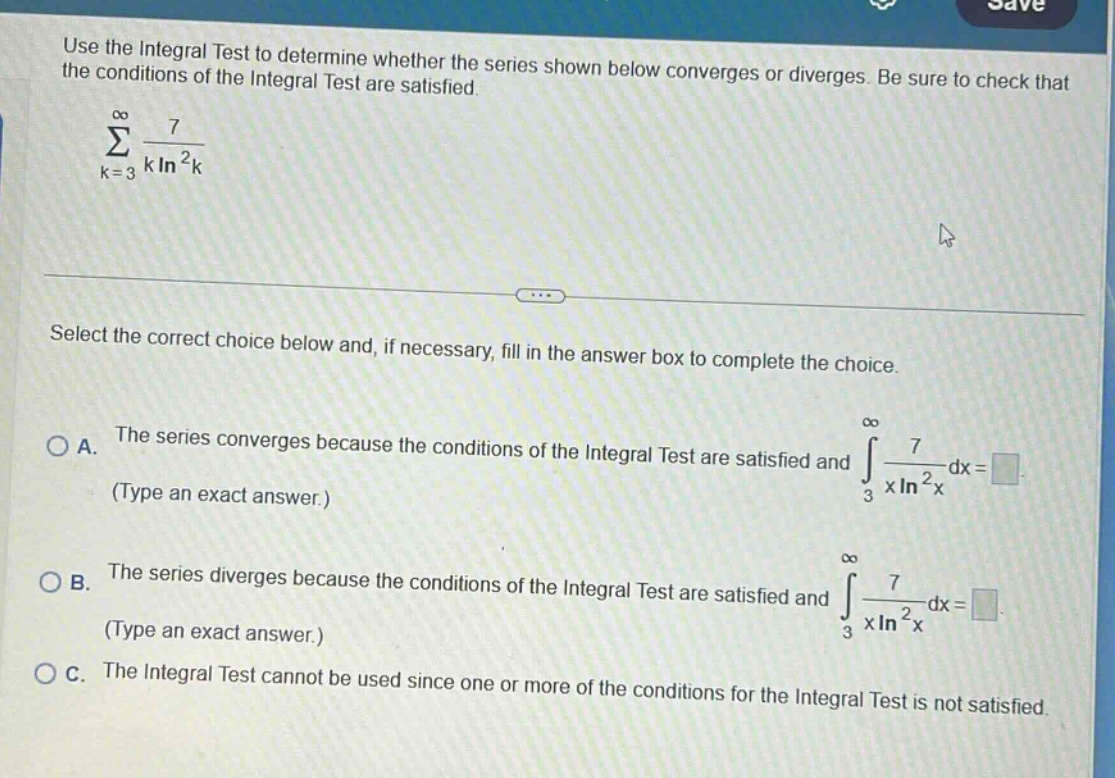
use the integral test to determine whether the series shown below converges or diverges. be sure to check that the conditions of the integral test are satisfied. \n∑k = 3 to ∞ 7/(k ln²k)\nselect the correct choice below and, if necessary, fill in the answer box to complete the choice.\na. the series converges because the conditions of the integral test are satisfied and ∫3 to ∞ 7/(x ln²x) dx = . (type an exact answer.)\nb. the series diverges because the conditions of the integral test are satisfied and ∫3 to ∞ 7/(x ln²x) dx = . (type an exact answer.)\nc. the integral test cannot be used since one or more of the conditions for the integral test is not satisfied.
Answer
Explanation:
Step1: Check Integral Test conditions
Let (f(x)=\frac{7}{x\ln^{2}x}), for (x\geq3). The function (f(x)) is positive, continuous and decreasing for (x\geq3) (since (f'(x)=-\frac{7(1 + 2\ln x)}{x^{2}\ln^{3}x}<0) for (x\geq3)).
Step2: Evaluate the improper - integral
Let (u = \ln x), then (du=\frac{1}{x}dx). When (x = 3), (u=\ln3), and as (x\rightarrow\infty), (u\rightarrow\infty). The integral (\int_{3}^{\infty}\frac{7}{x\ln^{2}x}dx=7\int_{\ln3}^{\infty}u^{- 2}du).
Step3: Calculate the definite - integral
Using the power - rule for integration (\int u^{n}du=\frac{u^{n + 1}}{n+1}+C) ((n\neq - 1)), we have (7\int_{\ln3}^{\infty}u^{-2}du=7\lim_{t\rightarrow\infty}\int_{\ln3}^{t}u^{-2}du=7\lim_{t\rightarrow\infty}\left[-u^{-1}\right]_{\ln3}^{t}).
Step4: Evaluate the limit
[ \begin{align*} 7\lim_{t\rightarrow\infty}\left[-u^{-1}\right]{\ln3}^{t}&=7\lim{t\rightarrow\infty}\left(-\frac{1}{t}+\frac{1}{\ln3}\right)\ &=\frac{7}{\ln3} \end{align*} ] Since the improper integral (\int_{3}^{\infty}\frac{7}{x\ln^{2}x}dx) converges (it has a finite value (\frac{7}{\ln3})), by the Integral Test, the series (\sum_{k = 3}^{\infty}\frac{7}{k\ln^{2}k}) converges.
Answer:
A. The series converges because the conditions of the Integral Test are satisfied and (\int_{3}^{\infty}\frac{7}{x\ln^{2}x}dx=\frac{7}{\ln3})