use integration by parts to evaluate the indefinite integral ∫e^6x sin(2x)
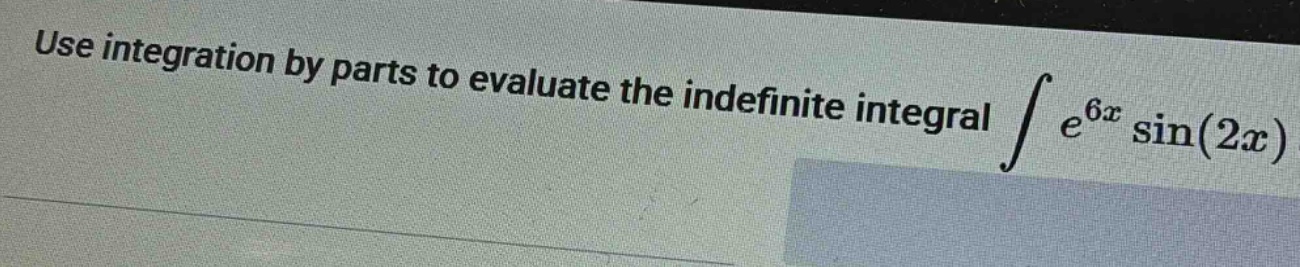
use integration by parts to evaluate the indefinite integral ∫e^6x sin(2x)
Answer
Explanation:
Step1: Apply integration - by - parts formula
The integration - by - parts formula is $\int u\mathrm{d}v=uv-\int v\mathrm{d}u$. Let $u = \sin(2x)$ and $\mathrm{d}v=e^{6x}\mathrm{d}x$. Then $\mathrm{d}u = 2\cos(2x)\mathrm{d}x$ and $v=\frac{1}{6}e^{6x}$. So, $\int e^{6x}\sin(2x)\mathrm{d}x=\frac{1}{6}e^{6x}\sin(2x)-\frac{1}{3}\int e^{6x}\cos(2x)\mathrm{d}x$.
Step2: Apply integration - by - parts again
For $\int e^{6x}\cos(2x)\mathrm{d}x$, let $u=\cos(2x)$ and $\mathrm{d}v = e^{6x}\mathrm{d}x$. Then $\mathrm{d}u=-2\sin(2x)\mathrm{d}x$ and $v=\frac{1}{6}e^{6x}$. So, $\int e^{6x}\cos(2x)\mathrm{d}x=\frac{1}{6}e^{6x}\cos(2x)+\frac{1}{3}\int e^{6x}\sin(2x)\mathrm{d}x$.
Step3: Substitute the second result into the first
Let $I=\int e^{6x}\sin(2x)\mathrm{d}x$. Then $I=\frac{1}{6}e^{6x}\sin(2x)-\frac{1}{3}\left(\frac{1}{6}e^{6x}\cos(2x)+\frac{1}{3}I\right)$. Expand the right - hand side: $I=\frac{1}{6}e^{6x}\sin(2x)-\frac{1}{18}e^{6x}\cos(2x)-\frac{1}{9}I$.
Step4: Solve for $I$
Add $\frac{1}{9}I$ to both sides: $I+\frac{1}{9}I=\frac{1}{6}e^{6x}\sin(2x)-\frac{1}{18}e^{6x}\cos(2x)$. Combine like terms: $\frac{9I + I}{9}=\frac{1}{6}e^{6x}\sin(2x)-\frac{1}{18}e^{6x}\cos(2x)$, so $\frac{10I}{9}=\frac{1}{6}e^{6x}\sin(2x)-\frac{1}{18}e^{6x}\cos(2x)$. Multiply both sides by $\frac{9}{10}$: $I=\frac{3}{20}e^{6x}\sin(2x)-\frac{1}{20}e^{6x}\cos(2x)+C$.
Answer:
$\frac{3}{20}e^{6x}\sin(2x)-\frac{1}{20}e^{6x}\cos(2x)+C$