use the interactive graph below to sketch a graph of $y = 4\\log_{3}(-x - 3)$. place the asymptote before…
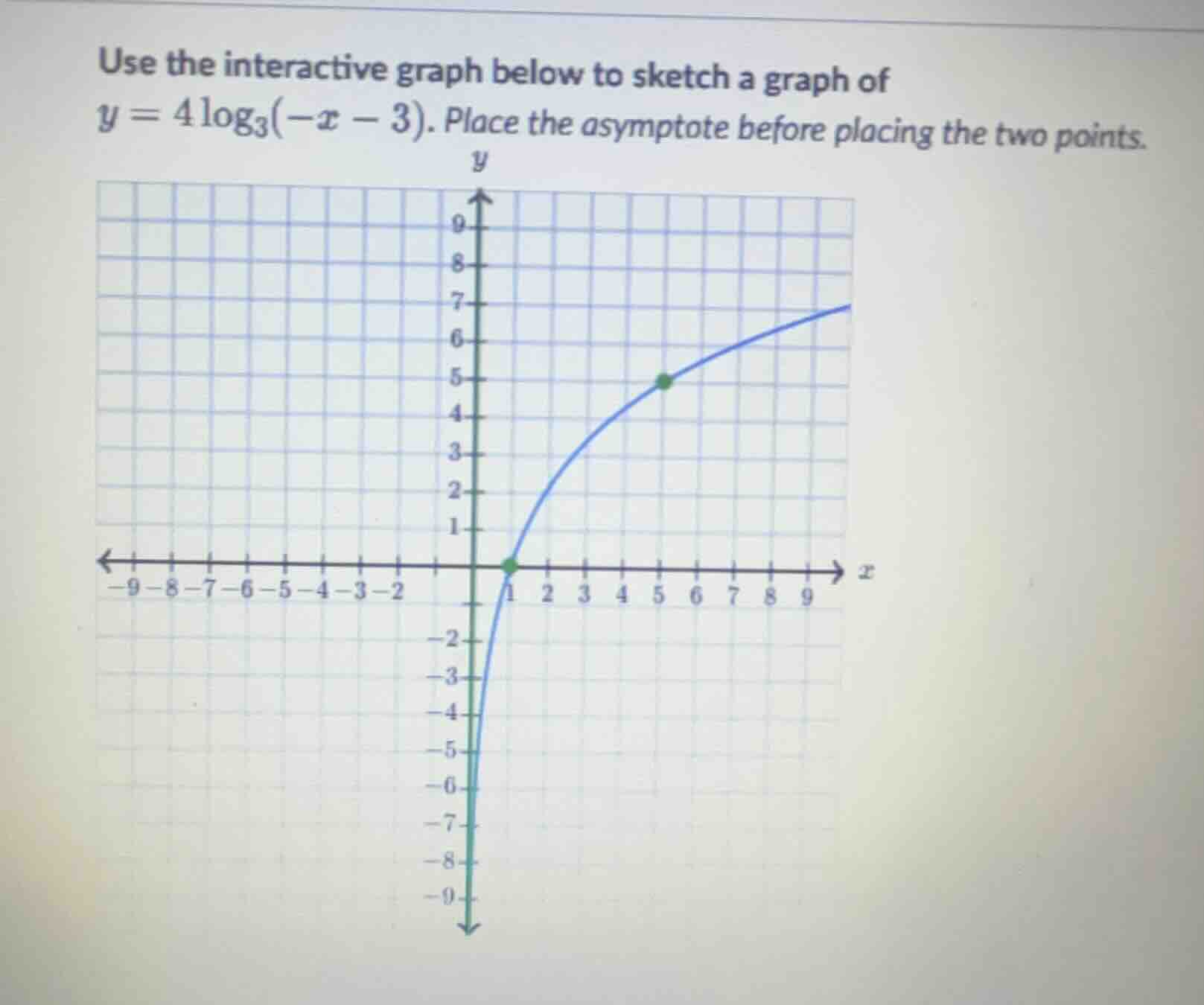
use the interactive graph below to sketch a graph of $y = 4\\log_{3}(-x - 3)$. place the asymptote before placing the two points.
Answer
Explanation:
Step1: Find the vertical asymptote
For the logarithmic function ( y = a\log_b(u) ), the vertical asymptote occurs where ( u = 0 ). Here, ( u=-x - 3 ), so set ( -x - 3=0 ). Solving for ( x ): ( -x=3 ) gives ( x=-3 ). So the vertical asymptote is ( x = - 3 ).
Step2: Find two points on the graph
Point 1: Let ( -x - 3 = 1 ) (since ( \log_b(1)=0 ) for any ( b>0,b\neq1 ))
Solve ( -x - 3 = 1 ): ( -x=4 ) so ( x=-4 ). Then ( y = 4\log_3(1)=4\times0 = 0 ). So one point is ( (-4,0) ).
Point 2: Let ( -x - 3 = 3 ) (since ( \log_3(3)=1 ))
Solve ( -x - 3 = 3 ): ( -x=6 ) so ( x=-6 ). Then ( y = 4\log_3(3)=4\times1 = 4 ). Wait, but looking at the graph, maybe another approach. Alternatively, let's check when ( x=-4 ), we have ( y = 4\log_3(1)=0 ) (point ( (-4,0) )). When ( x=-1 ), ( -x - 3=-1 - 3=-4 ), but log of negative is undefined. Wait, maybe I made a mistake. Wait, the function is ( y = 4\log_3(-x - 3) ), so the argument ( -x - 3>0\Rightarrow -x>3\Rightarrow x < - 3 ). Oh! I had a mistake earlier. The domain is ( x < - 3 ), so my previous point with ( x=-4 ) is valid (since ( -4 < - 3 )), ( x=-6 ) is also valid (( -6 < - 3 )). Wait, but the graph in the image has points at ( (1,0) ) and ( (5,5) )? No, maybe the graph in the image is a different function, but for our function ( y = 4\log_3(-x - 3) ), let's correct.
Wait, let's re - evaluate. The function ( y = 4\log_3(-x - 3) ) can be rewritten as ( y = 4\log_3(-(x + 3)) ), which is a reflection over the y - axis and a horizontal shift left by 3 units of ( y = 4\log_3(x) ).
Let's find points correctly:
Case 1: Let ( -x - 3=1\Rightarrow x=-4 ), ( y = 4\log_3(1)=0 ) (point ( (-4,0) ))
Case 2: Let ( -x - 3 = \frac{1}{3}\Rightarrow -x=3+\frac{1}{3}=\frac{10}{3}\Rightarrow x =-\frac{10}{3}\approx - 3.333 ), ( y = 4\log_3(\frac{1}{3})=4\times(- 1)=-4 )
Case 3: Let ( -x - 3 = 3\Rightarrow x=-6 ), ( y = 4\log_3(3)=4\times1 = 4 ) (point ( (-6,4) ))
But maybe the intended points are based on the transformation. The parent function ( y=\log_3(x) ) has vertical asymptote ( x = 0 ), point ( (1,0) ), ( (3,1) ). For ( y = 4\log_3(-x - 3) ), we have a reflection over the y - axis (replace ( x ) with ( -x )) and a horizontal shift left by 3 units (replace ( x ) with ( x + 3 )). So the vertical asymptote of ( y=\log_3(x) ) is ( x = 0 ), after reflection over y - axis it's ( x = 0 ), then shift left 3 units: ( x=-3 ) (which matches our earlier calculation). The point ( (1,0) ) on ( y=\log_3(x) ), after reflection over y - axis becomes ( (-1,0) ), then shift left 3 units: ( x=-1-3=-4 ), ( y = 0 ) (so point ( (-4,0) )). The point ( (3,1) ) on ( y=\log_3(x) ), after reflection over y - axis becomes ( (-3,1) ), then shift left 3 units: ( x=-3 - 3=-6 ), ( y = 4\times1 = 4 ) (so point ( (-6,4) )).
Answer:
The vertical asymptote is ( x=-3 ). Two points on the graph are ( (-4,0) ) and ( (-6,4) ) (or other valid points within the domain ( x < - 3 ) calculated using the function ( y = 4\log_3(-x - 3) )). To sketch the graph, first draw the vertical asymptote ( x=-3 ), then plot the points ( (-4,0) ) and ( (-6,4) ) (or other valid points) and draw the curve approaching the asymptote as ( x\rightarrow - 3^+ ) (from the right - hand side of the asymptote, since ( x < - 3 )) and extending to the left.