use the intermediate value theorem to prove that the equation x^6 - 9x^4 + 7 = x^5 - 8x^3 - 9 has at least…
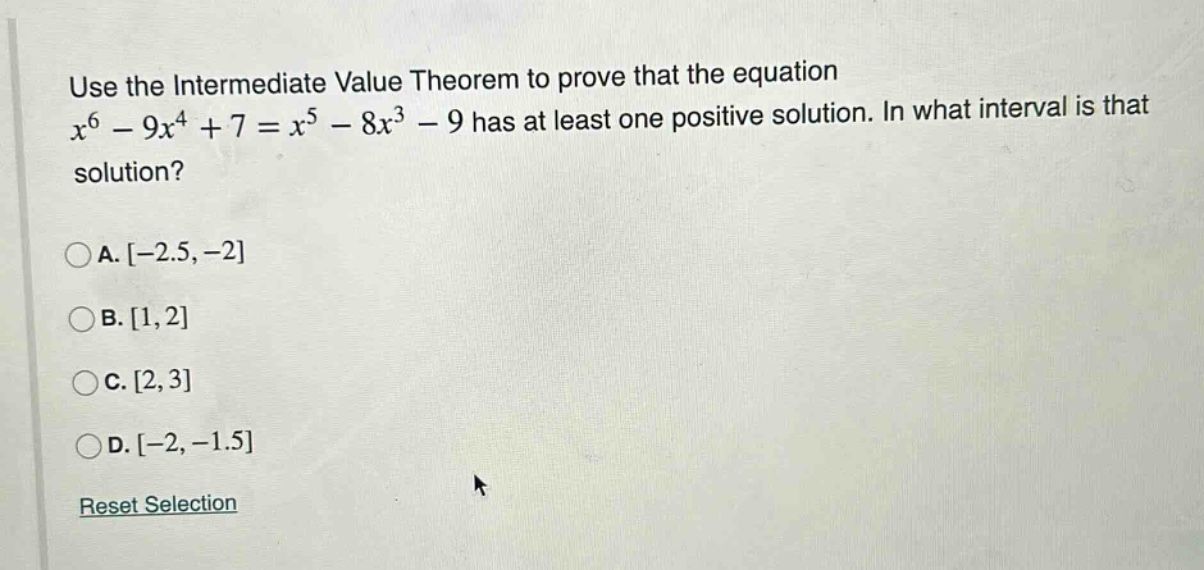
use the intermediate value theorem to prove that the equation x^6 - 9x^4 + 7 = x^5 - 8x^3 - 9 has at least one positive solution. in what interval is that solution?\n\na. -2.5, -2\nb. 1, 2\nc. 2, 3\nd. -2, -1.5\n\nreset selection
Answer
Explanation:
Step1: Rearrange the equation
Let (f(x)=x^{6}-x^{5}-9x^{4}+8x^{3}+16). We want to find where (f(x) = 0) for positive (x) values.
Step2: Evaluate (f(x)) at the endpoints of positive - valued intervals
Evaluate at (x = 1):
(f(1)=1^{6}-1^{5}-9\times1^{4}+8\times1^{3}+16=1 - 1-9 + 8+16=15)
Evaluate at (x = 2):
(f(2)=2^{6}-2^{5}-9\times2^{4}+8\times2^{3}+16=64 - 32-144 + 64+16=-32) Since (f(x)) is a polynomial, it is continuous everywhere. By the Intermediate - Value Theorem, since (f(1)=15>0) and (f(2)=-32 < 0), there must be at least one (c\in(1,2)) such that (f(c)=0).
Answer:
B. ([1,2])