use the intermediate value theorem to prove that the equation x³ = -5 has at least one negative solution. in…
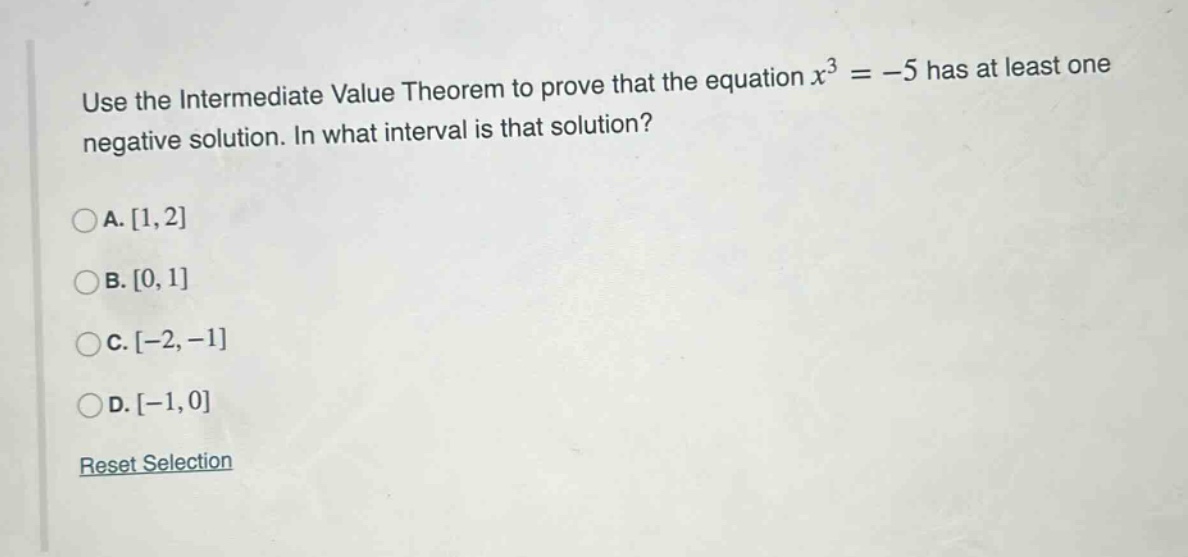
use the intermediate value theorem to prove that the equation x³ = -5 has at least one negative solution. in what interval is that solution?\n\na. 1,2\nb. 0,1\nc. -2,-1\nd. -1,0\n\nreset selection
Answer
Explanation:
Step1: Define the function
Let $f(x)=x^{3}+ 5$. The function $y = f(x)$ is a polynomial function, so it is continuous everywhere.
Step2: Evaluate the function at the endpoints of each interval
For interval A. $[1,2]$:
$f(1)=1^{3}+5=6$ and $f(2)=2^{3}+5 = 8 + 5=13$. Since $f(1)>0$ and $f(2)>0$, there is no sign - change in this interval.
For interval B. $[0,1]$:
$f(0)=0^{3}+5 = 5$ and $f(1)=1^{3}+5=6$. Since $f(0)>0$ and $f(1)>0$, there is no sign - change in this interval.
For interval C. $[-2,-1]$:
$f(-2)=(-2)^{3}+5=-8 + 5=-3$ and $f(-1)=(-1)^{3}+5=-1 + 5 = 4$. Since $f(-2)<0$ and $f(-1)>0$, by the Intermediate Value Theorem, there exists at least one $c\in[-2,-1]$ such that $f(c)=0$, which means $c^{3}=-5$.
For interval D. $[-1,0]$:
$f(-1)=(-1)^{3}+5 = 4$ and $f(0)=0^{3}+5=5$. Since $f(-1)>0$ and $f(0)>0$, there is no sign - change in this interval.
Answer:
C. $[-2,-1]$