a. use the intermediate value theorem to show that the following equation has a solution on the given…
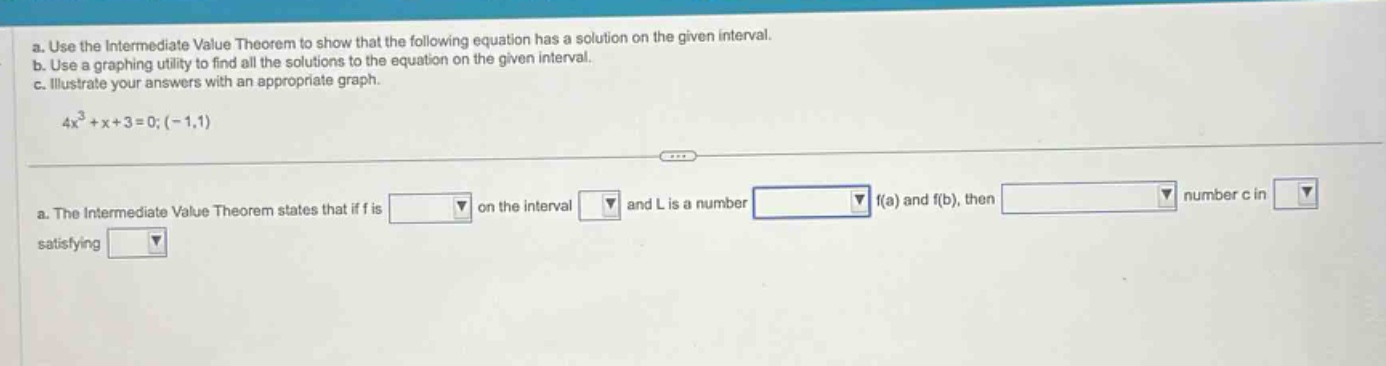
a. use the intermediate value theorem to show that the following equation has a solution on the given interval. b. use a graphing utility to find all the solutions to the equation on the given interval. c. illustrate your answers with an appropriate graph. 4x³ + x + 3 = 0; (-1,1) a. the intermediate value theorem states that if f is on the interval and l is a number f(a) and f(b), then number c in satisfying
Answer
Answer:
a. The Intermediate - Value Theorem states that if (f) is continuous on the interval ([a,b]) and (L) is a number between (f(a)) and (f(b)), then there exists a number (c) in ((a,b)) satisfying (f(c)=L).
Let (f(x) = 4x^{3}+x + 3). The function (y = f(x)) is a polynomial function, and polynomial functions are continuous everywhere, so (f(x)) is continuous on the interval ([- 1,1]).
First, find (f(-1)):
Step1: Substitute (x=-1) into (f(x))
[f(-1)=4(-1)^{3}+(-1)+3] [f(-1)=4\times(-1)-1 + 3=-4 - 1+3=-2]
Next, find (f(1)):
Step2: Substitute (x = 1) into (f(x))
[f(1)=4(1)^{3}+1+3=4 + 1+3=8]
We want to show that the equation (4x^{3}+x + 3 = 0) has a solution. Here, (L = 0), and since (f(-1)=-2) and (f(1)=8), and (0) is between (-2) and (8), by the Intermediate - Value Theorem, there exists a number (c\in(-1,1)) such that (f(c)=0), which means the equation (4x^{3}+x + 3 = 0) has a solution in the interval ((-1,1)).
b. Using a graphing utility (such as a graphing calculator or software like Desmos), we can graph the function (y = 4x^{3}+x + 3). The (x) - values of the points where the graph of (y = 4x^{3}+x + 3) intersects the (x) - axis are the solutions of the equation (4x^{3}+x + 3 = 0). By graphing, we find that the solution of the equation (4x^{3}+x + 3 = 0) in the interval ((-1,1)) is approximately (x\approx - 0.83).
c. When we graph the function (y = 4x^{3}+x + 3), we see that it is a smooth - shaped curve (since it is a polynomial). The (y) - intercept is (y=f(0)=3). The function is decreasing for (x) values less than a certain point and increasing for (x) values greater than that point. The graph crosses the (x) - axis at the point corresponding to the solution we found in part (b), which is in the interval ((-1,1)).