use lhôpitals rule to evaluate lim (6x² + 7x)/(x³ + 2x + 4) as x→∞. then determine the limit using limit…
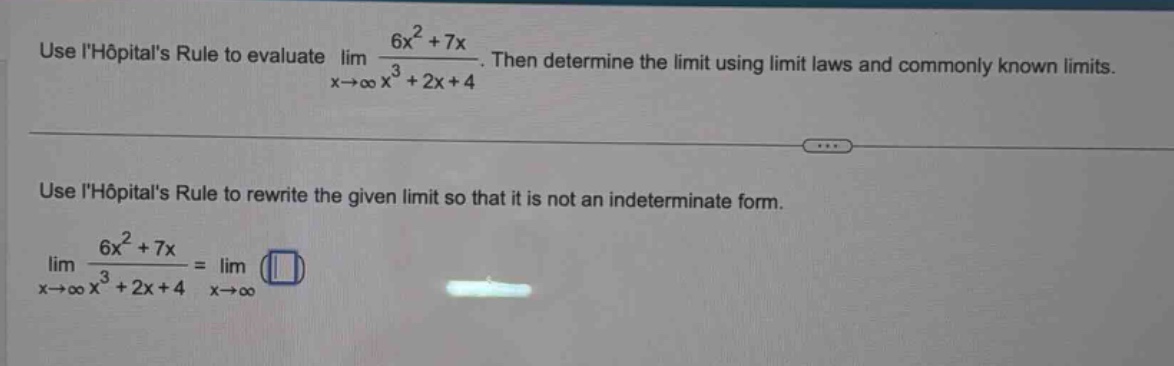
use lhôpitals rule to evaluate lim (6x² + 7x)/(x³ + 2x + 4) as x→∞. then determine the limit using limit laws and commonly known limits. use lhôpitals rule to rewrite the given limit so that it is not an indeterminate form. lim (6x² + 7x)/(x³ + 2x + 4) as x→∞ = lim as x→∞
Answer
Explanation:
Step1: Check indeterminate form
As (x\to\infty), (\lim_{x\to\infty}\frac{6x^{2}+7x}{x^{3}+2x + 4}) is in the (\frac{\infty}{\infty}) form.
Step2: Apply L'Hopital's Rule
Differentiate the numerator and denominator. The derivative of (6x^{2}+7x) is (12x + 7), and the derivative of (x^{3}+2x + 4) is (3x^{2}+2). So (\lim_{x\to\infty}\frac{6x^{2}+7x}{x^{3}+2x + 4}=\lim_{x\to\infty}\frac{12x + 7}{3x^{2}+2}).
Step3: Check form and apply L'Hopital's Rule again
(\lim_{x\to\infty}\frac{12x + 7}{3x^{2}+2}) is still in the (\frac{\infty}{\infty}) form. Differentiate again. The derivative of (12x + 7) is (12), and the derivative of (3x^{2}+2) is (6x). So (\lim_{x\to\infty}\frac{12x + 7}{3x^{2}+2}=\lim_{x\to\infty}\frac{12}{6x}).
Answer:
(0)