use lhôpitals rule to find the limit. lim(x→ - ∞) (x^6 - 31)/(x - 7) apply lhôpitals rule so that the lim(x→…
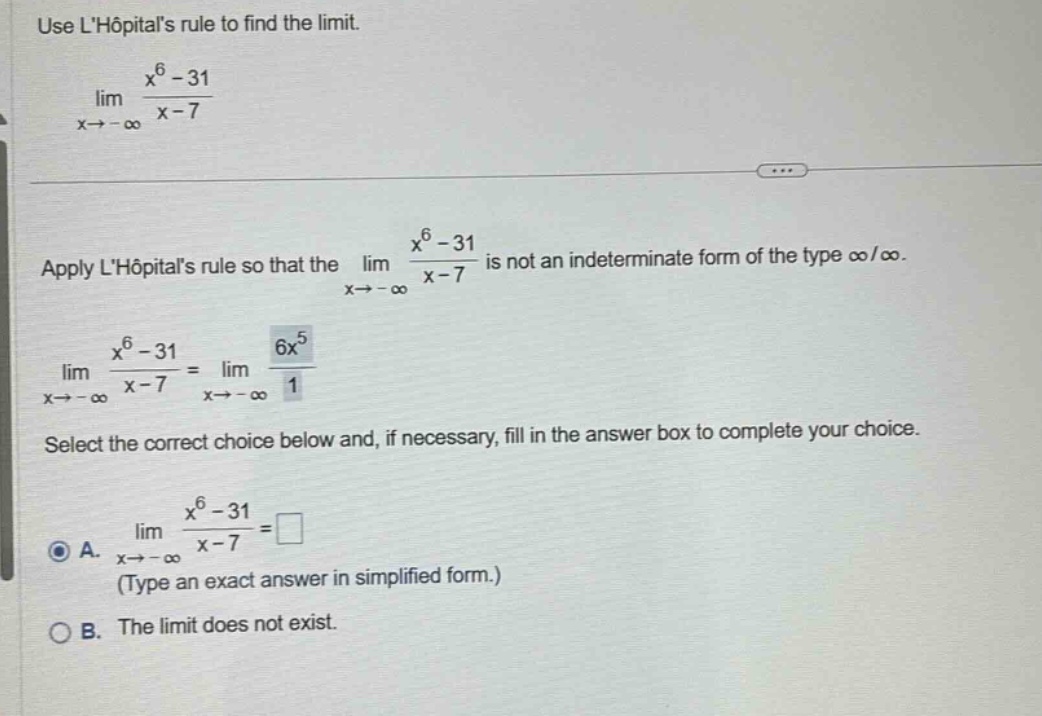
use lhôpitals rule to find the limit. lim(x→ - ∞) (x^6 - 31)/(x - 7) apply lhôpitals rule so that the lim(x→ - ∞) (x^6 - 31)/(x - 7) is not an indeterminate form of the type ∞/∞. lim(x→ - ∞) (x^6 - 31)/(x - 7)=lim(x→ - ∞) (6x^5)/1 select the correct choice below and, if necessary, fill in the answer box to complete your choice. a. lim(x→ - ∞) (x^6 - 31)/(x - 7)=□ (type an exact answer in simplified form.) b. the limit does not exist.
Answer
Explanation:
Step1: Check indeterminate form
As $x\to-\infty$, $\frac{x^{6}-31}{x - 7}$ is of the form $\frac{\infty}{-\infty}$, so L'Hopital's rule can be applied.
Step2: Differentiate numerator and denominator
The derivative of $y = x^{6}-31$ is $y^\prime=6x^{5}$ using the power - rule $\frac{d}{dx}(x^{n})=nx^{n - 1}$, and the derivative of $y=x - 7$ is $y^\prime = 1$. So, $\lim_{x\to-\infty}\frac{x^{6}-31}{x - 7}=\lim_{x\to-\infty}\frac{6x^{5}}{1}$.
Step3: Evaluate the new limit
As $x\to-\infty$, $6x^{5}\to-\infty$ since the power of $x$ is odd and the coefficient $6>0$.
Answer:
B. The limit does not exist.