use lhopitals rule to find the following limit. lim x→0 x²/ln(secx) lim x→0 x²/ln(secx) = (type an exact…
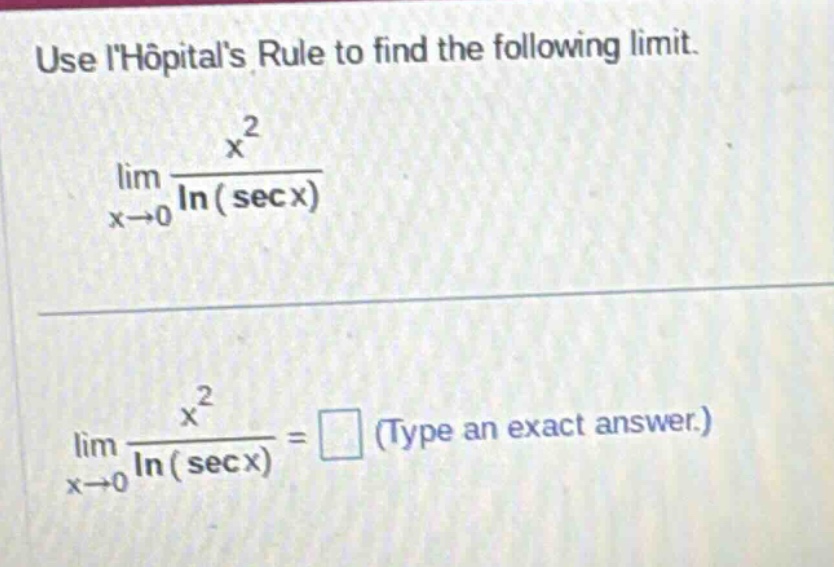
use lhopitals rule to find the following limit. lim x→0 x²/ln(secx) lim x→0 x²/ln(secx) = (type an exact answer.)
Answer
Explanation:
Step1: Check indeterminate form
When (x\rightarrow0), (\lim_{x\rightarrow0}x^{2}=0) and (\lim_{x\rightarrow0}\ln(\sec x)=\ln(\sec0)=\ln(1) = 0). So, it is in the (\frac{0}{0}) form and L'Hopital's Rule can be applied.
Step2: Differentiate numerator and denominator
The derivative of (y = x^{2}) is (y'=2x) using the power - rule ((x^{n})'=nx^{n - 1}). The derivative of (y=\ln(\sec x)) using the chain - rule: Let (u = \sec x), then (y=\ln(u)). (\frac{dy}{du}=\frac{1}{u}) and (\frac{du}{dx}=\sec x\tan x). So, (\frac{d}{dx}\ln(\sec x)=\frac{\sec x\tan x}{\sec x}=\tan x).
Step3: Apply L'Hopital's Rule
(\lim_{x\rightarrow0}\frac{x^{2}}{\ln(\sec x)}=\lim_{x\rightarrow0}\frac{2x}{\tan x}). When (x\rightarrow0), this is still in the (\frac{0}{0}) form.
Step4: Differentiate again
The derivative of (y = 2x) is (y'=2), and the derivative of (y=\tan x) is (y'=\sec^{2}x) using the formula ((\tan x)'=\sec^{2}x).
Step5: Evaluate the limit
(\lim_{x\rightarrow0}\frac{2x}{\tan x}=\lim_{x\rightarrow0}\frac{2}{\sec^{2}x}). Since (\lim_{x\rightarrow0}\sec^{2}x=\sec^{2}(0)=1), then (\lim_{x\rightarrow0}\frac{2}{\sec^{2}x}=2).
Answer:
(2)