use lhospitals rule to find the exact value of the limit. lim(x→∞) (1 + 7/x)^x
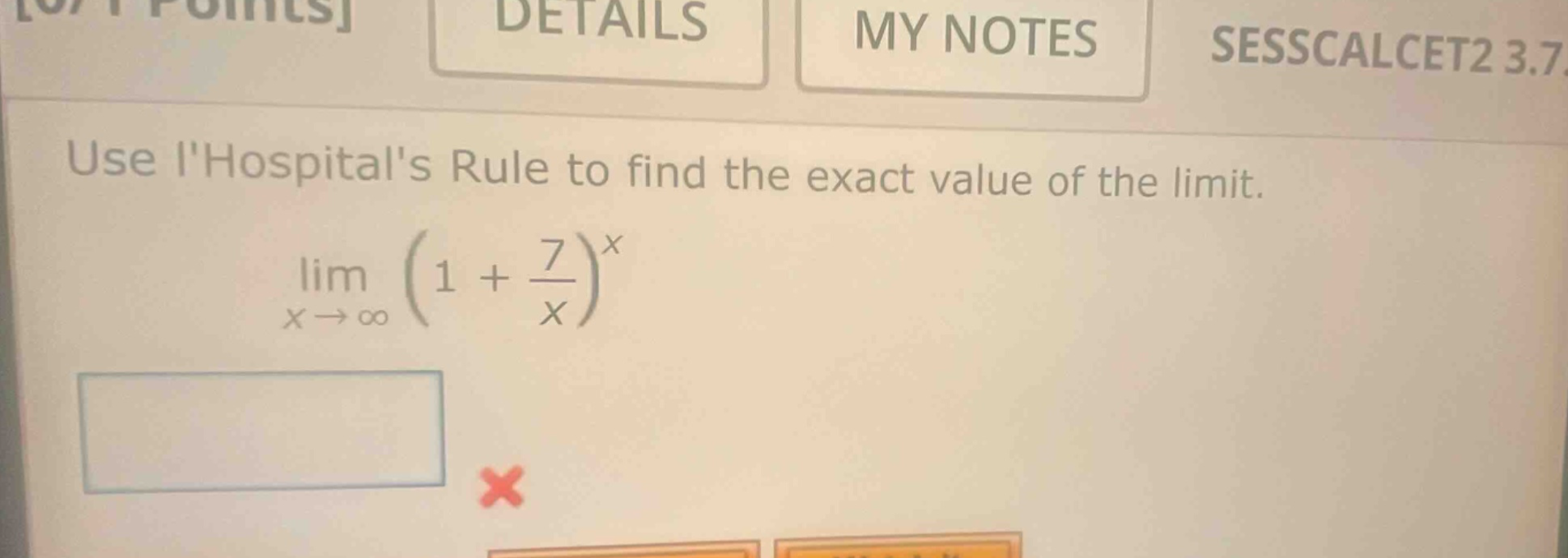
use lhospitals rule to find the exact value of the limit. lim(x→∞) (1 + 7/x)^x
Answer
Explanation:
Step1: Let $y=(1 + \frac{7}{x})^x$
Take natural - logarithm of both sides: $\ln y=x\ln(1 + \frac{7}{x})$.
Step2: Rewrite the limit
We want to find $\lim_{x\rightarrow\infty}\ln y=\lim_{x\rightarrow\infty}x\ln(1 + \frac{7}{x})=\lim_{x\rightarrow\infty}\frac{\ln(1 + \frac{7}{x})}{\frac{1}{x}}$. As $x\rightarrow\infty$, we have the indeterminate form $\frac{0}{0}$.
Step3: Apply L'Hospital's Rule
Differentiate the numerator and denominator. The derivative of $\ln(1+\frac{7}{x})$ with respect to $x$ is $\frac{1}{1+\frac{7}{x}}\cdot(-\frac{7}{x^{2}})=-\frac{7}{x(x + 7)}$, and the derivative of $\frac{1}{x}$ with respect to $x$ is $-\frac{1}{x^{2}}$. Then $\lim_{x\rightarrow\infty}\frac{\ln(1+\frac{7}{x})}{\frac{1}{x}}=\lim_{x\rightarrow\infty}\frac{-\frac{7}{x(x + 7)}}{-\frac{1}{x^{2}}}=\lim_{x\rightarrow\infty}\frac{7x^{2}}{x(x + 7)}$.
Step4: Simplify the limit
$\lim_{x\rightarrow\infty}\frac{7x^{2}}{x(x + 7)}=\lim_{x\rightarrow\infty}\frac{7x}{x + 7}$. Divide both the numerator and denominator by $x$: $\lim_{x\rightarrow\infty}\frac{7x}{x + 7}=\lim_{x\rightarrow\infty}\frac{7}{1+\frac{7}{x}} = 7$.
Step5: Find the original limit
Since $\lim_{x\rightarrow\infty}\ln y = 7$, and $y = e^{\ln y}$, then $\lim_{x\rightarrow\infty}y=e^{7}$.
Answer:
$e^{7}$