use properties of limits to find the indicated limit. it may be necessary to rewrite an expression before…
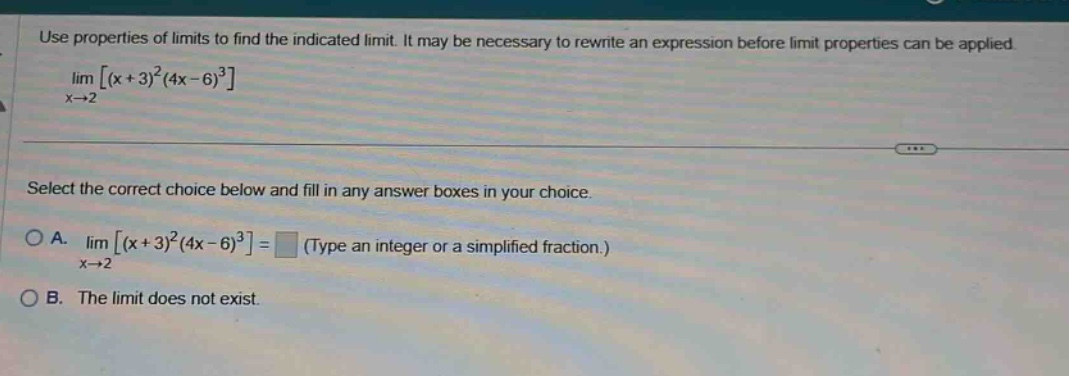
use properties of limits to find the indicated limit. it may be necessary to rewrite an expression before limit properties can be applied. limx→2(x + 3)^2(4x - 6)^3 select the correct choice below and fill in any answer boxes in your choice. a. limx→2(x + 3)^2(4x - 6)^3= (type an integer or a simplified fraction.) b. the limit does not exist.
Answer
Explanation:
Step1: Apply product - limit rule
$\lim_{x\rightarrow a}[f(x)g(x)]=\lim_{x\rightarrow a}f(x)\cdot\lim_{x\rightarrow a}g(x)$. Let $f(x)=(x + 3)^2$ and $g(x)=(4x-6)^3$. Then $\lim_{x\rightarrow2}[(x + 3)^2(4x-6)^3]=\lim_{x\rightarrow2}(x + 3)^2\cdot\lim_{x\rightarrow2}(4x-6)^3$.
Step2: Apply power - limit rule $\lim_{x\rightarrow a}[f(x)]^n=[\lim_{x\rightarrow a}f(x)]^n$
For $\lim_{x\rightarrow2}(x + 3)^2$, we have $[\lim_{x\rightarrow2}(x + 3)]^2$. Substitute $x = 2$ into $x+3$: $\lim_{x\rightarrow2}(x + 3)=2 + 3=5$, so $[\lim_{x\rightarrow2}(x + 3)]^2=5^2 = 25$.
Step3: Apply power - limit rule and sum - difference rule
For $\lim_{x\rightarrow2}(4x-6)^3$, first use the sum - difference rule $\lim_{x\rightarrow a}[f(x)-g(x)]=\lim_{x\rightarrow a}f(x)-\lim_{x\rightarrow a}g(x)$. So $\lim_{x\rightarrow2}(4x-6)=\lim_{x\rightarrow2}(4x)-\lim_{x\rightarrow2}(6)$. Then use the constant - multiple rule $\lim_{x\rightarrow a}[cf(x)]=c\lim_{x\rightarrow a}f(x)$, we get $4\lim_{x\rightarrow2}x-\lim_{x\rightarrow2}6$. Substitute $x = 2$: $4\times2-6=8 - 6=2$. Then $[\lim_{x\rightarrow2}(4x-6)]^3=2^3 = 8$.
Step4: Calculate the final limit
Multiply the two results: $\lim_{x\rightarrow2}(x + 3)^2\cdot\lim_{x\rightarrow2}(4x-6)^3=25\times8=200$.
Answer:
A. $\lim_{x\rightarrow2}[(x + 3)^2(4x-6)^3]=200$