use the properties of limits to help decide whether the limit exists. if the limit exists, find its value…
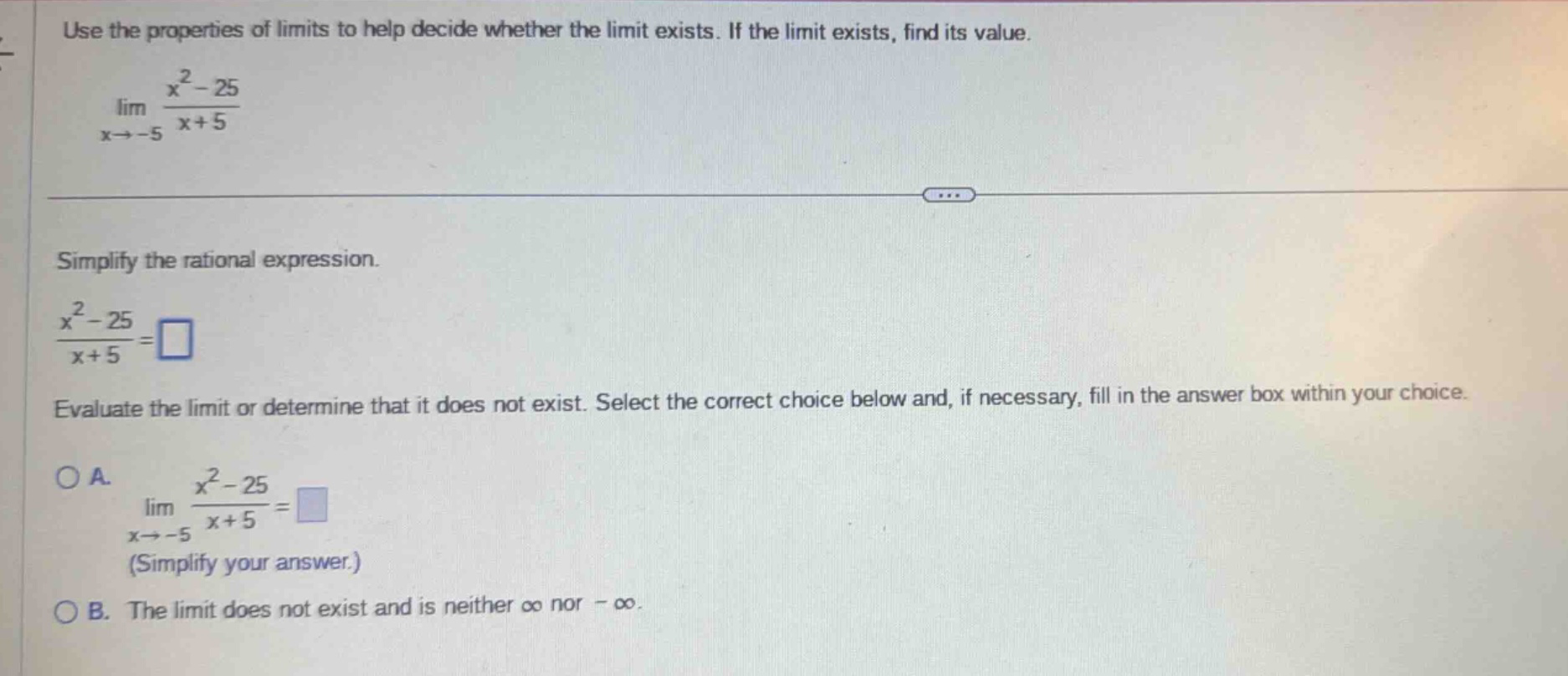
use the properties of limits to help decide whether the limit exists. if the limit exists, find its value. lim(x→ - 5) (x² - 25)/(x + 5) simplify the rational expression. (x² - 25)/(x + 5)=□ evaluate the limit or determine that it does not exist. select the correct choice below and, if necessary, fill in the answer box within your choice. oa. lim(x→ - 5) (x² - 25)/(x + 5)=□ (simplify your answer.) ob. the limit does not exist and is neither ∞ nor -∞.
Answer
Explanation:
Step1: Factor the numerator
We know that $x^{2}-25=(x + 5)(x - 5)$ by the difference - of - squares formula $a^{2}-b^{2}=(a + b)(a - b)$ where $a=x$ and $b = 5$. So, $\frac{x^{2}-25}{x + 5}=\frac{(x + 5)(x - 5)}{x+5}$.
Step2: Simplify the rational expression
Cancel out the common factor $(x + 5)$ (for $x\neq - 5$). Then $\frac{(x + 5)(x - 5)}{x + 5}=x - 5$.
Step3: Evaluate the limit
Now, we find $\lim_{x\rightarrow - 5}\frac{x^{2}-25}{x + 5}=\lim_{x\rightarrow - 5}(x - 5)$. Substitute $x=-5$ into $x - 5$. We get $-5-5=-10$.
Answer:
Simplify the rational expression: $x - 5$ A. $\lim_{x\rightarrow - 5}\frac{x^{2}-25}{x + 5}=-10$