(a) use the quotient rule to differentiate the function f(x) = (tan x - 1)/sec x. f(x) = (b) simplify the…
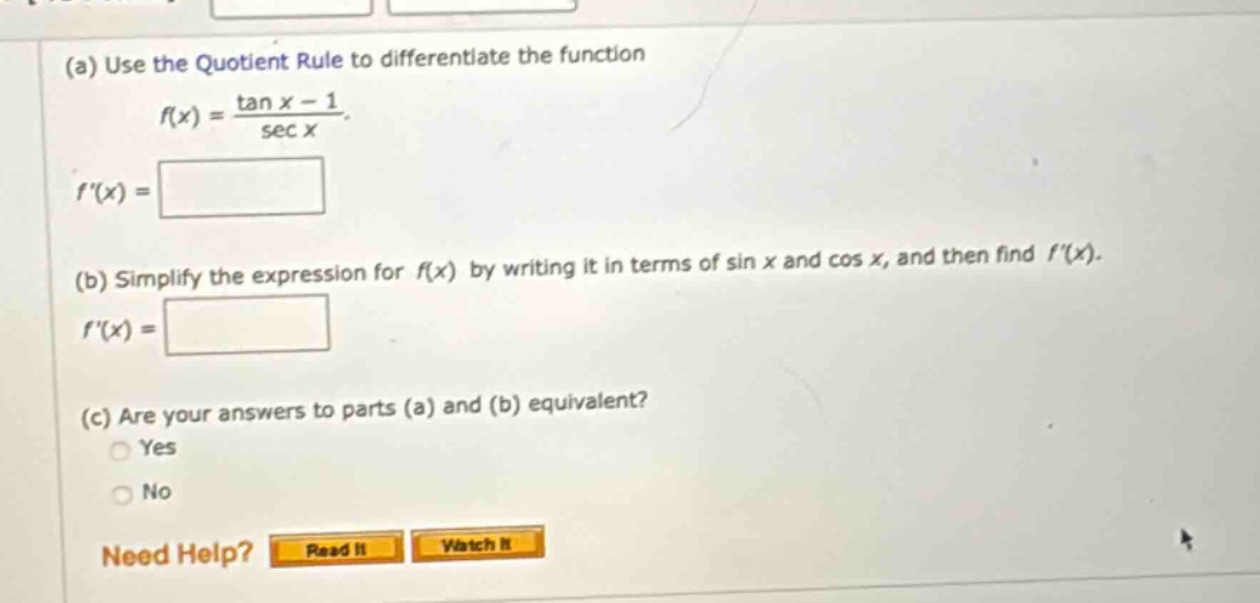
(a) use the quotient rule to differentiate the function f(x) = (tan x - 1)/sec x. f(x) = (b) simplify the expression for f(x) by writing it in terms of sin x and cos x, and then find f(x). f(x) = (c) are your answers to parts (a) and (b) equivalent? yes no need help? read it watch it
Answer
Explanation:
Step1: Recall Quotient Rule
The Quotient Rule states that if $y = \frac{u}{v}$, then $y'=\frac{u'v - uv'}{v^{2}}$. For $f(x)=\frac{\tan x - 1}{\sec x}$, let $u=\tan x - 1$ and $v = \sec x$. We know that $u'=\sec^{2}x$ and $v'=\sec x\tan x$.
Step2: Apply Quotient Rule
[ \begin{align*} f'(x)&=\frac{\sec^{2}x\cdot\sec x-(\tan x - 1)\cdot\sec x\tan x}{\sec^{2}x}\ &=\frac{\sec^{3}x-\sec x\tan^{2}x+\sec x\tan x}{\sec^{2}x}\ &=\sec x-\frac{\tan^{2}x}{\sec x}+\frac{\tan x}{\sec x}\ &=\sec x-\sin^{2}x\sec x+\sin x \end{align*} ]
Step3: Rewrite $f(x)$ in terms of $\sin x$ and $\cos x$
We know that $\tan x=\frac{\sin x}{\cos x}$ and $\sec x=\frac{1}{\cos x}$. So $f(x)=\frac{\frac{\sin x}{\cos x}-1}{\frac{1}{\cos x}}=\sin x-\cos x$.
Step4: Differentiate $f(x)=\sin x-\cos x$
Using the sum - difference rule and the derivatives of $\sin x$ and $\cos x$ ($(\sin x)'=\cos x$ and $(\cos x)'=-\sin x$), we get $f'(x)=\cos x+\sin x$.
Step5: Simplify the first - derived expression
[ \begin{align*} \sec x-\sin^{2}x\sec x+\sin x&=\frac{1}{\cos x}-\frac{\sin^{2}x}{\cos x}+\sin x\ &=\frac{1 - \sin^{2}x}{\cos x}+\sin x\ &=\frac{\cos^{2}x}{\cos x}+\sin x\ &=\cos x+\sin x \end{align*} ]
Answer:
(a) $\sec x-\sin^{2}x\sec x+\sin x$ (b) $\cos x+\sin x$ (c) Yes