use the root test to determine whether the series convergent or div\n∑(n = 1 to ∞) ((n² + 9)/(4n² +…
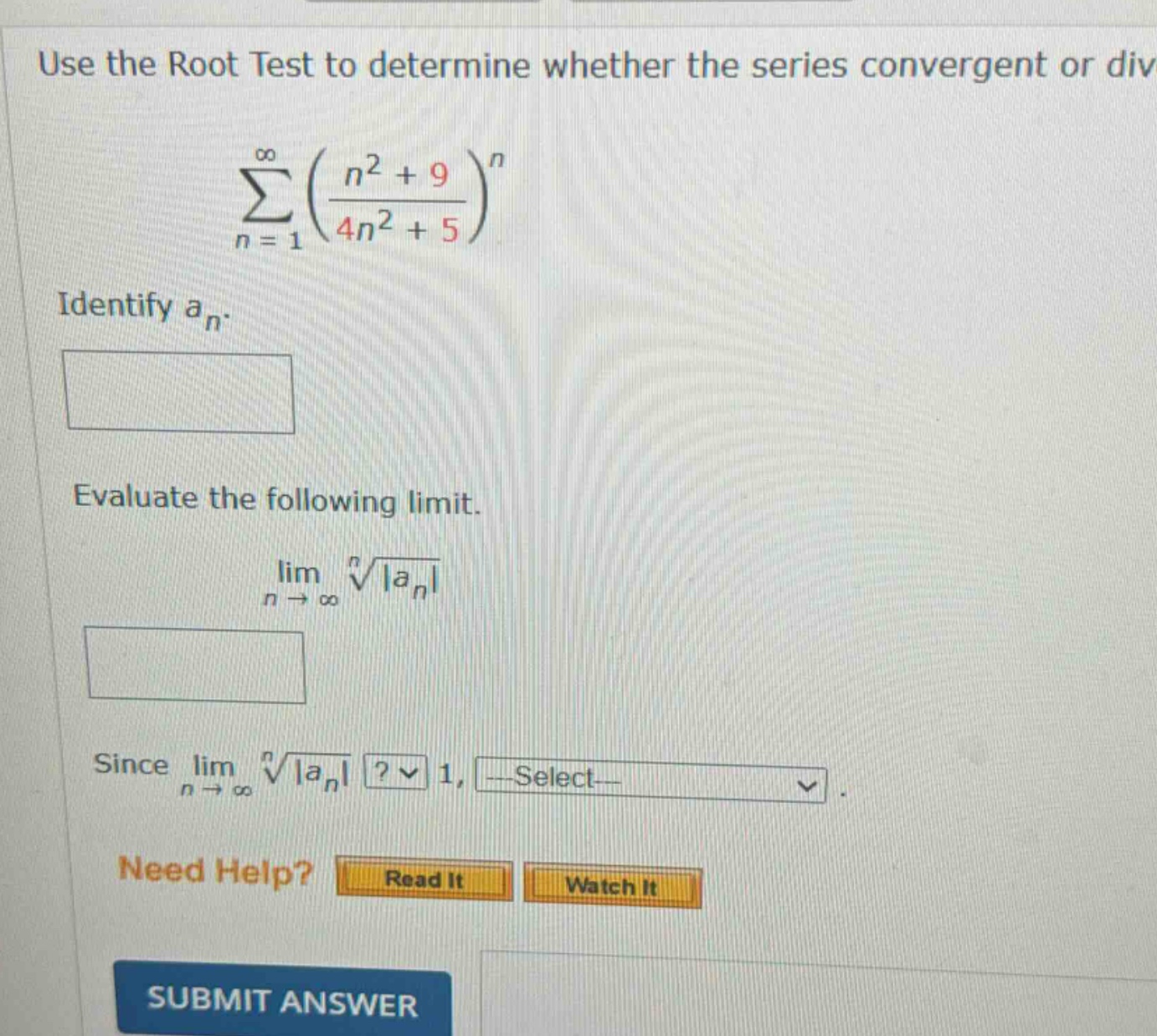
use the root test to determine whether the series convergent or div\n∑(n = 1 to ∞) ((n² + 9)/(4n² + 5))ⁿ\nidentify aₙ.\nevaluate the following limit.\nlim(n → ∞) ⁿ√|aₙ|\nsince lim(n → ∞) ⁿ√|aₙ|? 1, select-\nneed help? read it watch it\nsubmit answer
Answer
Explanation:
Step1: Identify (a_n)
The (n) -th term of the series (\sum_{n = 1}^{\infty}(\frac{n^{2}+9}{4n^{2}+5})^{n}) is (a_n=(\frac{n^{2}+9}{4n^{2}+5})^{n}).
Step2: Calculate (\lim_{n\rightarrow\infty}\sqrt[n]{\vert a_n\vert})
Since (a_n = (\frac{n^{2}+9}{4n^{2}+5})^{n}), then (\sqrt[n]{\vert a_n\vert}=\frac{n^{2}+9}{4n^{2}+5}). Now, find the limit (\lim_{n\rightarrow\infty}\frac{n^{2}+9}{4n^{2}+5}). Divide both the numerator and denominator by (n^{2}): (\lim_{n\rightarrow\infty}\frac{n^{2}+9}{4n^{2}+5}=\lim_{n\rightarrow\infty}\frac{1 + \frac{9}{n^{2}}}{4+\frac{5}{n^{2}}}). As (n\rightarrow\infty), (\frac{9}{n^{2}}\rightarrow0) and (\frac{5}{n^{2}}\rightarrow0). So (\lim_{n\rightarrow\infty}\frac{1+\frac{9}{n^{2}}}{4 + \frac{5}{n^{2}}}=\frac{1+0}{4 + 0}=\frac{1}{4}).
Step3: Apply the Root - Test
The Root - Test states that if (\lim_{n\rightarrow\infty}\sqrt[n]{\vert a_n\vert}=L), then if (L<1), the series (\sum_{n = 1}^{\infty}a_n) converges; if (L > 1), the series diverges; if (L = 1), the Root - Test is inconclusive. Since (L=\frac{1}{4}<1), the series (\sum_{n = 1}^{\infty}(\frac{n^{2}+9}{4n^{2}+5})^{n}) converges.
Answer:
- (a_n=(\frac{n^{2}+9}{4n^{2}+5})^{n})
- (\lim_{n\rightarrow\infty}\sqrt[n]{\vert a_n\vert}=\frac{1}{4})
- Since (\lim_{n\rightarrow\infty}\sqrt[n]{\vert a_n\vert}<1), the series converges.