use a series to estimate the following integrals value with an error of magnitude less than 10^(-8).\n0.3\n∫…
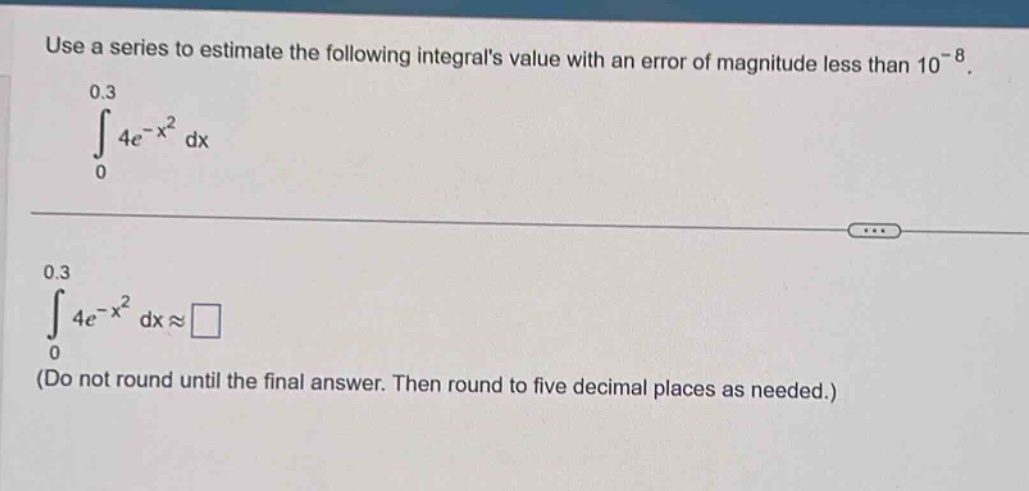
use a series to estimate the following integrals value with an error of magnitude less than 10^(-8).\n0.3\n∫ 4e^(-x^2) dx\n0\n0.3\n∫ 4e^(-x^2) dx ≈ \n(do not round until the final answer. then round to five decimal places as needed.)
Answer
Explanation:
Step1: Recall the Maclaurin series for $e^u$
The Maclaurin series for $e^u=\sum_{n = 0}^{\infty}\frac{u^n}{n!}=1 + u+\frac{u^2}{2!}+\frac{u^3}{3!}+\cdots$. Let $u=-x^{2}$, then $e^{-x^{2}}=\sum_{n = 0}^{\infty}\frac{(-x^{2})^{n}}{n!}=\sum_{n = 0}^{\infty}\frac{(- 1)^{n}x^{2n}}{n!}=1 - x^{2}+\frac{x^{4}}{2!}-\frac{x^{6}}{3!}+\cdots$.
Step2: Multiply by 4
$4e^{-x^{2}} = 4\sum_{n = 0}^{\infty}\frac{(-1)^{n}x^{2n}}{n!}=\sum_{n = 0}^{\infty}\frac{4(-1)^{n}x^{2n}}{n!}=4-4x^{2}+\frac{4x^{4}}{2!}-\frac{4x^{6}}{3!}+\cdots$.
Step3: Integrate term - by - term
$\int_{0}^{0.3}4e^{-x^{2}}dx=\int_{0}^{0.3}\sum_{n = 0}^{\infty}\frac{4(-1)^{n}x^{2n}}{n!}dx=\sum_{n = 0}^{\infty}\frac{4(-1)^{n}}{n!}\int_{0}^{0.3}x^{2n}dx$. Since $\int_{0}^{0.3}x^{2n}dx=\left[\frac{x^{2n + 1}}{2n+1}\right]{0}^{0.3}=\frac{(0.3)^{2n + 1}}{2n+1}$, then $\int{0}^{0.3}4e^{-x^{2}}dx=\sum_{n = 0}^{\infty}\frac{4(-1)^{n}(0.3)^{2n + 1}}{n!(2n+1)}$.
Step4: Determine the number of terms for the error bound
The series $\sum_{n = 0}^{\infty}\frac{4(-1)^{n}(0.3)^{2n + 1}}{n!(2n+1)}$ is an alternating series. For an alternating series $\sum_{n = 0}^{\infty}(-1)^{n}a_{n}$ ($a_{n}\gt0$, $a_{n+1}\leq a_{n}$, $\lim_{n\rightarrow\infty}a_{n}=0$), the error bound $|E_N|\leq a_{N + 1}$. We want $a_{N+1}=\frac{4(0.3)^{2(N + 1)+1}}{(N+1)!(2(N + 1)+1)}\lt10^{-8}$. Let's check for $N$: For $n = 0$: $a_{0}=\frac{4(0.3)^{1}}{0!(1)}=4\times0.3 = 1.2$. For $n = 1$: $a_{1}=\frac{4(0.3)^{3}}{1!(3)}=\frac{4\times0.027}{3}=0.036$. For $n = 2$: $a_{2}=\frac{4(0.3)^{5}}{2!(5)}=\frac{4\times0.00243}{10}=0.000972$. For $n = 3$: $a_{3}=\frac{4(0.3)^{7}}{3!(7)}=\frac{4\times0.0002187}{42}\approx2.083\times10^{-6}$. For $n = 4$: $a_{4}=\frac{4(0.3)^{9}}{4!(9)}=\frac{4\times0.000019683}{216}\approx3.645\times10^{-8}$. For $n = 5$: $a_{5}=\frac{4(0.3)^{11}}{5!(11)}=\frac{4\times0.00000177147}{1320}\approx5.37\times10^{-11}\lt10^{-8}$. So we use the sum of the first 5 terms ($N = 4$) of the series: $S_4=\sum_{n = 0}^{4}\frac{4(-1)^{n}(0.3)^{2n + 1}}{n!(2n+1)}=\frac{4(0.3)^{1}}{0!(1)}-\frac{4(0.3)^{3}}{1!(3)}+\frac{4(0.3)^{5}}{2!(5)}-\frac{4(0.3)^{7}}{3!(7)}+\frac{4(0.3)^{9}}{4!(9)}$ $=1.2-0.036 + 0.000972-2.083\times10^{-6}+3.645\times10^{-8}$ $=1.16497$.
Answer:
$1.16497$