use the shell method to find the volume of the solid generated by revolving the regions bounded by the…
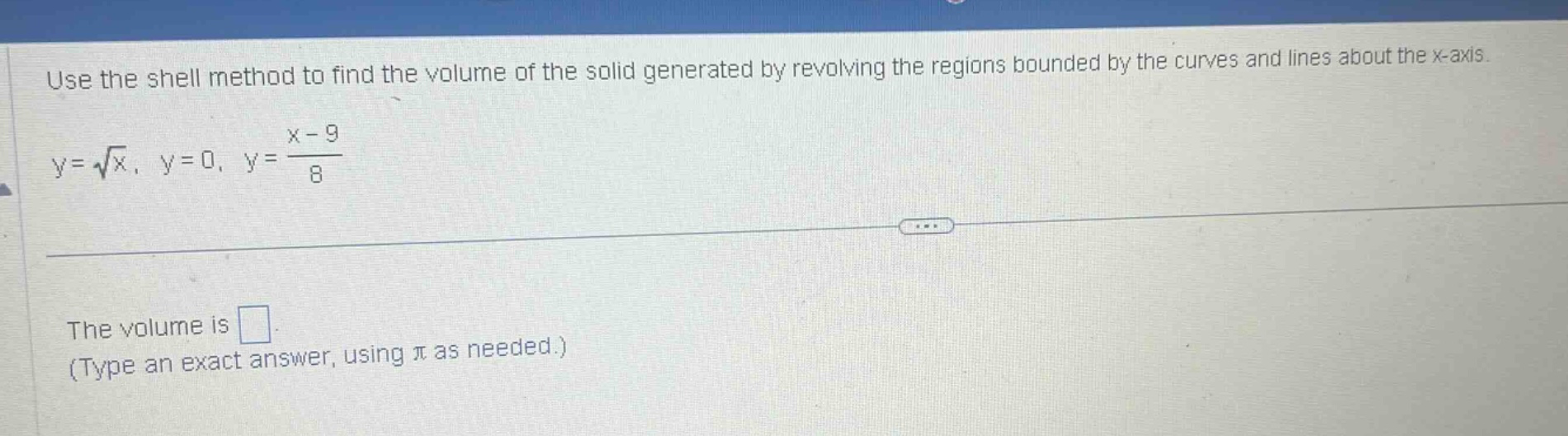
use the shell method to find the volume of the solid generated by revolving the regions bounded by the curves and lines about the x - axis.\ny = \\sqrt{x}, y = 0, y = \\frac{x - 9}{8}\nthe volume is \n(type an exact answer, using \\pi as needed.)
Answer
Explanation:
Step1: Find intersection points
Set $\sqrt{x}=\frac{x - 9}{8}$. Let $t=\sqrt{x}(t\geq0)$, then $t=\frac{t^{2}-9}{8}$, which simplifies to $8t=t^{2}-9$ or $t^{2}-8t - 9 = 0$. Factoring gives $(t - 9)(t+1)=0$. Since $t\geq0$, $t = 9$ and $x=t^{2}=81$. Also, $\sqrt{x}=0$ when $x = 0$ and $\frac{x - 9}{8}=0$ when $x = 9$.
Step2: Use the shell - method formula for volume about x - axis
The shell - method formula for volume $V$ of a solid of revolution about the $x$ - axis using horizontal shells is $V = 2\pi\int_{c}^{d}y\left(x_{right}-x_{left}\right)dy$. We need to express $x$ in terms of $y$. For $y=\sqrt{x}$, $x = y^{2}$; for $y=\frac{x - 9}{8}$, $x=8y + 9$. The limits of integration for $y$ are from $y = 0$ to $y = 9$. $x_{right}=8y + 9$ and $x_{left}=y^{2}$. So $V=2\pi\int_{0}^{9}y\left((8y + 9)-y^{2}\right)dy$.
Step3: Expand the integrand
$y\left((8y + 9)-y^{2}\right)=8y^{2}+9y - y^{3}$.
Step4: Integrate term - by - term
$\int(8y^{2}+9y - y^{3})dy=8\times\frac{y^{3}}{3}+9\times\frac{y^{2}}{2}-\frac{y^{4}}{4}+C$.
Step5: Evaluate the definite integral
$V = 2\pi\left[\frac{8y^{3}}{3}+\frac{9y^{2}}{2}-\frac{y^{4}}{4}\right]_{0}^{9}$ $V = 2\pi\left(\frac{8\times9^{3}}{3}+\frac{9\times9^{2}}{2}-\frac{9^{4}}{4}\right)$ $V = 2\pi\left(8\times\frac{729}{3}+\frac{9\times81}{2}-\frac{6561}{4}\right)$ $V = 2\pi\left(1944+\frac{729}{2}-\frac{6561}{4}\right)$ $V = 2\pi\left(\frac{7776 + 1458-6561}{4}\right)$ $V = 2\pi\times\frac{2673}{4}=\frac{2673\pi}{2}$.
Answer:
$\frac{2673\pi}{2}$