use substitution to find the given indefinite integral.\n int \frac { 5 } { 11 + 6 x } d x \n int \frac { 5…
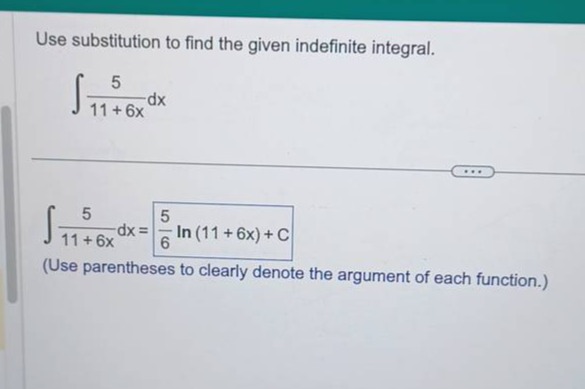
use substitution to find the given indefinite integral.\n int \frac { 5 } { 11 + 6 x } d x \n int \frac { 5 } { 11 + 6 x } d x = \frac { 5 } { 6 } ln ( 11 + 6 x ) + c \n(use parentheses to clearly denote the argument of each function.)
Answer
Explanation:
Step1: Let (u = 11 + 6x)
Differentiate (u) with respect to (x): (du=6dx), so (dx=\frac{1}{6}du)
Step2: Substitute into the integral
(\int\frac{5}{11 + 6x}dx=\int\frac{5}{u}\cdot\frac{1}{6}du) (=\frac{5}{6}\int\frac{1}{u}du)
Step3: Integrate (\frac{1}{u})
Since (\int\frac{1}{u}du=\ln|u|+C) (for (u>0) in this context as (11 + 6x>0) when considering the domain of the natural - logarithm in the real - valued case for the original function), we have (\frac{5}{6}\int\frac{1}{u}du=\frac{5}{6}\ln(u)+C)
Step4: Substitute back (u = 11+6x)
(\frac{5}{6}\ln(11 + 6x)+C)
Answer:
(\frac{5}{6}\ln(11 + 6x)+C)