use synthetic substitution to evaluate the given value and determine the remainder. f (x) = -4x⁴ + 9x³ + 8x²…
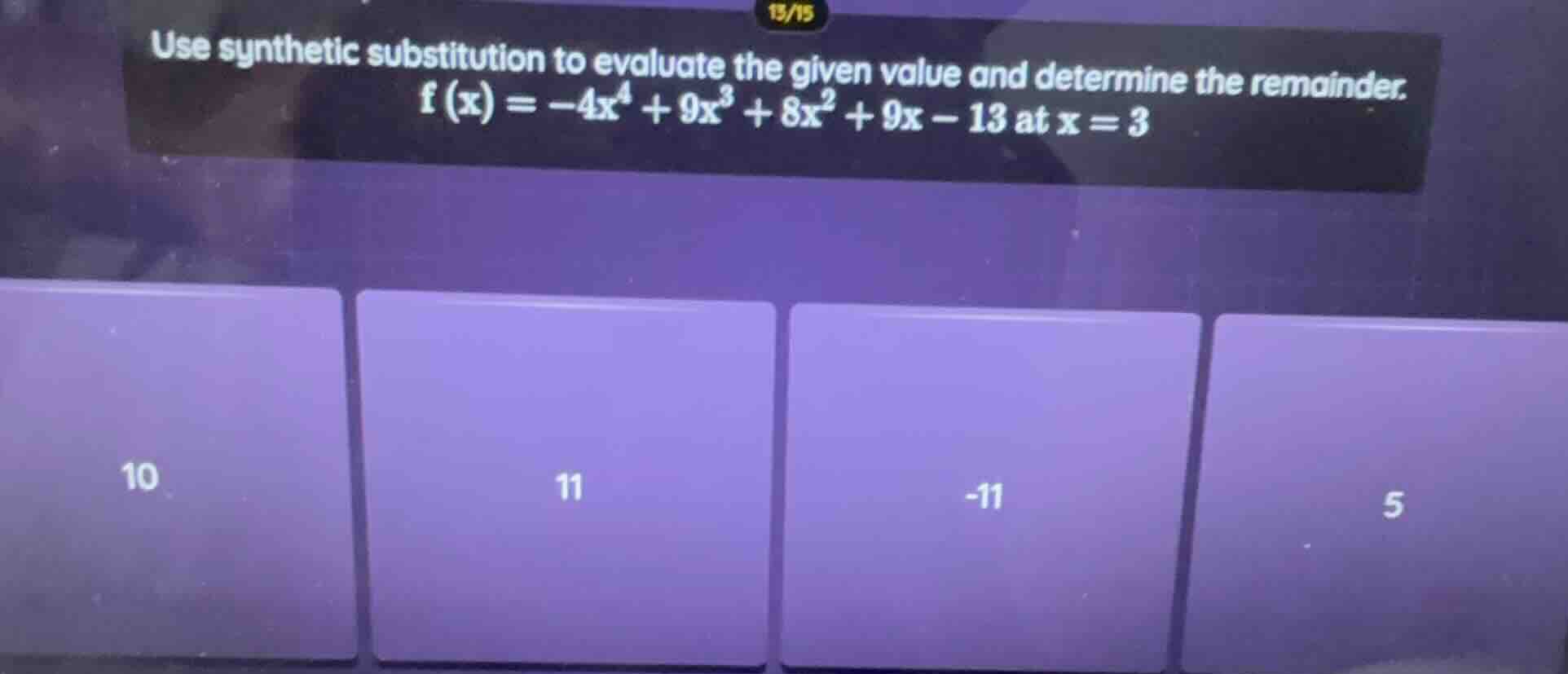
use synthetic substitution to evaluate the given value and determine the remainder. f (x) = -4x⁴ + 9x³ + 8x² + 9x - 13 at x = 3
Answer
Explanation:
Step1: Set up synthetic substitution
Write the coefficients of the polynomial: (-4), (9), (8), (9), (-13) and the value (x = 3) for synthetic division. [ \begin{array}{r|rrrrr} 3 & -4 & 9 & 8 & 9 & -13 \ & & & & & \ \hline & -4 & & & & \ \end{array} ]
Step2: Bring down the leading coefficient
Bring down the (-4). [ \begin{array}{r|rrrrr} 3 & -4 & 9 & 8 & 9 & -13 \ & & & & & \ \hline & -4 & & & & \ \end{array} ]
Step3: Multiply and add for each column
- Multiply (-4) by (3) to get (-12), then add to (9): (9 + (-12) = -3) [ \begin{array}{r|rrrrr} 3 & -4 & 9 & 8 & 9 & -13 \ & & -12 & & & \ \hline & -4 & -3 & & & \ \end{array} ]
- Multiply (-3) by (3) to get (-9), then add to (8): (8 + (-9) = -1) [ \begin{array}{r|rrrrr} 3 & -4 & 9 & 8 & 9 & -13 \ & & -12 & -9 & & \ \hline & -4 & -3 & -1 & & \ \end{array} ]
- Multiply (-1) by (3) to get (-3), then add to (9): (9 + (-3) = 6) [ \begin{array}{r|rrrrr} 3 & -4 & 9 & 8 & 9 & -13 \ & & -12 & -9 & -3 & \ \hline & -4 & -3 & -1 & 6 & \ \end{array} ]
- Multiply (6) by (3) to get (18), then add to (-13): (-13 + 18 = 5) [ \begin{array}{r|rrrrr} 3 & -4 & 9 & 8 & 9 & -13 \ & & -12 & -9 & -3 & 18 \ \hline & -4 & -3 & -1 & 6 & 5 \ \end{array} ]
Answer:
The remainder is (5), so the value of (f(3)) is (5).