use the table to estimate ∫₀⁴⁰ f(x) dx. assume that f(x) is an increasing function.\n\nx 0 10 20 30 40\nf(x)…
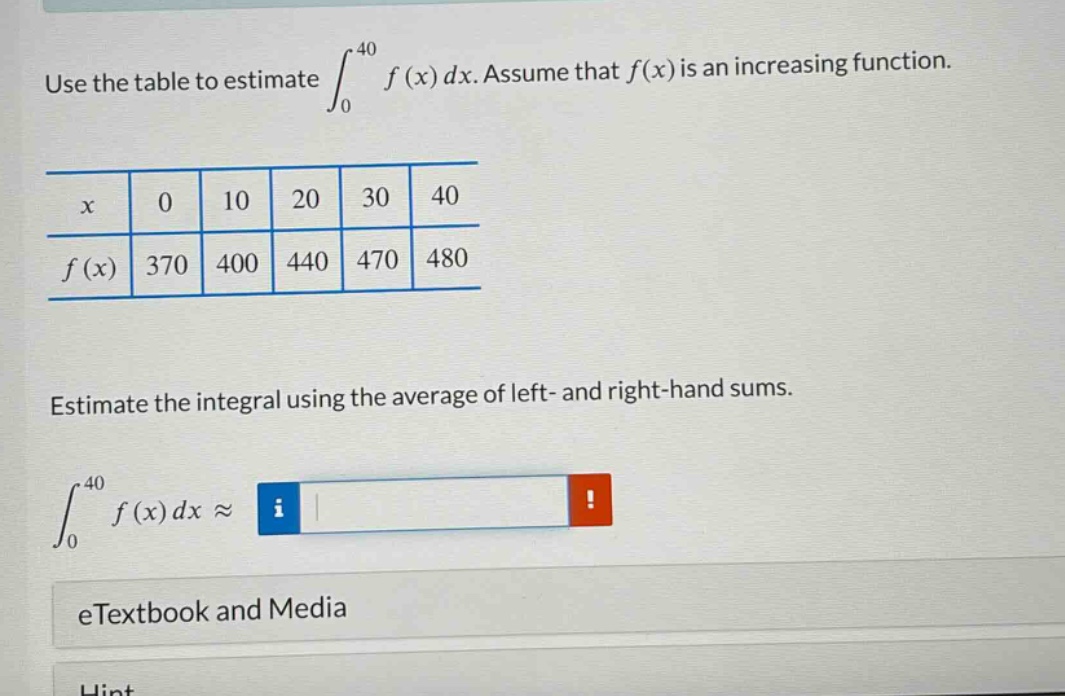
use the table to estimate ∫₀⁴⁰ f(x) dx. assume that f(x) is an increasing function.\n\nx 0 10 20 30 40\nf(x) 370 400 440 470 480\n\nestimate the integral using the average of left - and right - hand sums.\n\n∫₀⁴⁰ f(x) dx ≈
Answer
Explanation:
Step1: Calculate left - hand sum
The left - hand sum $L$ for $\int_{0}^{40}f(x)dx$ with $\Delta x = 10$ is $L=\sum_{i = 0}^{3}f(x_i)\Delta x$. Here, $x_0 = 0,x_1=10,x_2 = 20,x_3=30$ and $\Delta x=10$. So $L=(370 + 400+440 + 470)\times10=16800$.
Step2: Calculate right - hand sum
The right - hand sum $R$ for $\int_{0}^{40}f(x)dx$ with $\Delta x = 10$ is $R=\sum_{i = 1}^{4}f(x_i)\Delta x$. Here, $x_1 = 10,x_2=20,x_3 = 30,x_4=40$ and $\Delta x=10$. So $R=(400 + 440+470 + 480)\times10=17900$.
Step3: Calculate the average of left - and right - hand sums
The average of the left - hand sum and the right - hand sum is $\frac{L + R}{2}$. Substitute $L = 16800$ and $R=17900$ into the formula: $\frac{16800+17900}{2}=\frac{34700}{2}=17350$.
Answer:
$17350$