use a table of values to estimate the intercepts and turning points of the function. then graph f(x)=x^4…
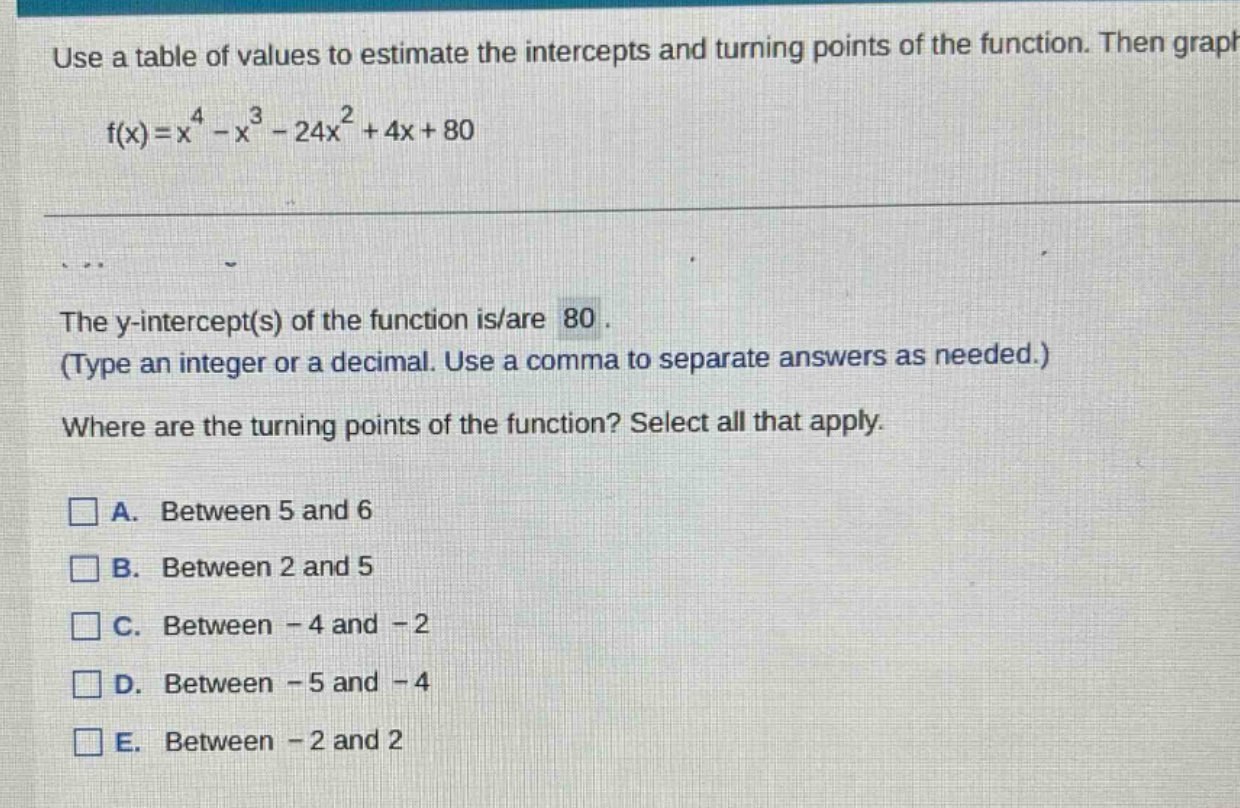
use a table of values to estimate the intercepts and turning points of the function. then graph f(x)=x^4 - x^3 - 24x^2 + 4x + 80\nthe y - intercept(s) of the function is/are 80. (type an integer or a decimal. use a comma to separate answers as needed.)\nwhere are the turning points of the function? select all that apply.\na. between 5 and 6\nb. between 2 and 5\nc. between - 4 and - 2\nd. between - 5 and - 4\ne. between - 2 and 2
Answer
Explanation:
Step1: Recall derivative concept
The turning - points of a function (y = f(x)) occur where (f^{\prime}(x)=0). First, find the derivative of (f(x)=x^{4}-x^{3}-24x^{2}+4x + 80). Using the power rule ((x^{n})^\prime=nx^{n - 1}), we have (f^{\prime}(x)=4x^{3}-3x^{2}-48x + 4).
Step2: Use a table of values
We can also test some values of (x) to estimate where the function changes from increasing to decreasing or vice - versa. Let's test (x=-5): (f(-5)=(-5)^{4}-(-5)^{3}-24(-5)^{2}+4(-5)+80=625 + 125-600-20 + 80=210) Let (x=-4): (f(-4)=(-4)^{4}-(-4)^{3}-24(-4)^{2}+4(-4)+80=256+64 - 384-16 + 80=0) Let (x=-2): (f(-2)=(-2)^{4}-(-2)^{3}-24(-2)^{2}+4(-2)+80=16 + 8-96-8 + 80=0) Let (x = 2): (f(2)=2^{4}-2^{3}-24\times2^{2}+4\times2+80=16-8 - 96 + 8+80=-0) Let (x = 5): (f(5)=5^{4}-5^{3}-24\times5^{2}+4\times5+80=625-125 - 600+20 + 80=0) Let (x = 6): (f(6)=6^{4}-6^{3}-24\times6^{2}+4\times6+80=1296-216-864 + 24+80=220) We can observe that the function changes its direction between (-5) and (-4), between (-4) and (-2), and between (2) and (5).
Answer:
B. Between 2 and 5 C. Between - 4 and - 2 D. Between - 5 and - 4