use a taylor series to approximate the following definite integral. retain as many terms as needed to ensure…
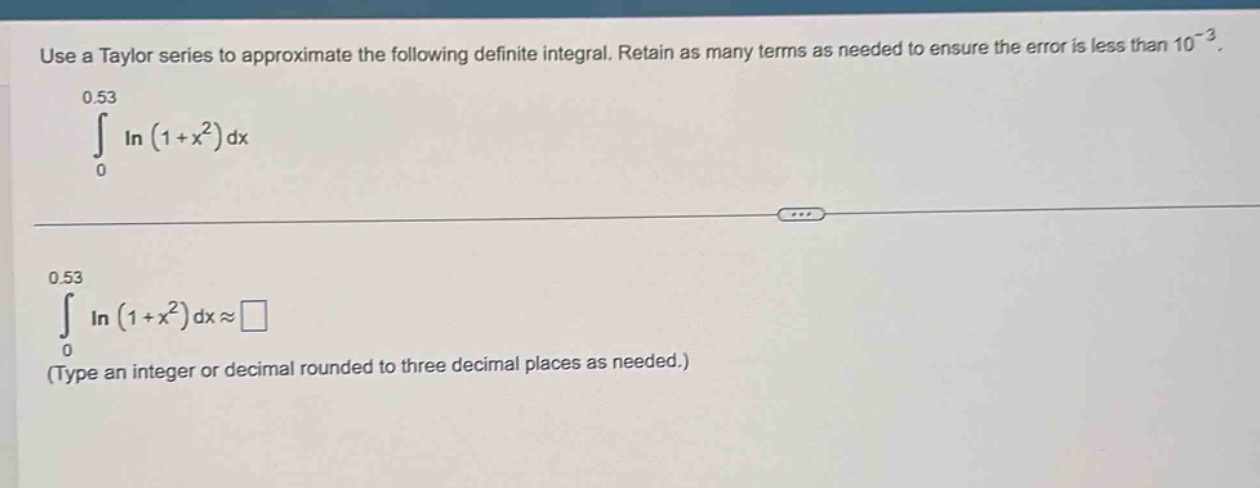
use a taylor series to approximate the following definite integral. retain as many terms as needed to ensure the error is less than 10^(-3). 0.53 ∫ in (1 + x^2) dx 0 0.53 ∫ in (1 + x^2) dx ≈ 0 (type an integer or decimal rounded to three decimal places as needed.)
Answer
Explanation:
Step1: Recall Taylor - series of $\ln(1 + t)$
The Taylor - series of $\ln(1 + t)$ about $t = 0$ is $\ln(1 + t)=\sum_{n = 1}^{\infty}\frac{(- 1)^{n + 1}}{n}t^{n}=t-\frac{t^{2}}{2}+\frac{t^{3}}{3}-\frac{t^{4}}{4}+\cdots$, for $|t|\lt1$. Let $t=x^{2}$, then $\ln(1 + x^{2})=\sum_{n = 1}^{\infty}\frac{(-1)^{n + 1}}{n}(x^{2})^{n}=\sum_{n = 1}^{\infty}\frac{(-1)^{n + 1}}{n}x^{2n}=x^{2}-\frac{x^{4}}{2}+\frac{x^{6}}{3}-\frac{x^{8}}{4}+\cdots$.
Step2: Integrate the Taylor - series term - by - term
[ \begin{align*} \int_{0}^{0.53}\ln(1 + x^{2})dx&=\int_{0}^{0.53}\sum_{n = 1}^{\infty}\frac{(-1)^{n + 1}}{n}x^{2n}dx\ &=\sum_{n = 1}^{\infty}\frac{(-1)^{n + 1}}{n}\int_{0}^{0.53}x^{2n}dx\ &=\sum_{n = 1}^{\infty}\frac{(-1)^{n + 1}}{n}\left[\frac{x^{2n + 1}}{2n+1}\right]{0}^{0.53}\ &=\sum{n = 1}^{\infty}\frac{(-1)^{n + 1}}{n(2n + 1)}(0.53)^{2n+1} \end{align*} ]
Step3: Calculate the sum until the error is less than $10^{-3}$
When $n = 1$: [ \frac{(-1)^{1 + 1}}{1\times(2\times1 + 1)}(0.53)^{2\times1+1}=\frac{1}{3}(0.53)^{3}=\frac{0.53^{3}}{3}\approx\frac{0.148877}{3}\approx0.0496 ] When $n = 2$: [ \frac{(-1)^{2 + 1}}{2\times(2\times2+1)}(0.53)^{2\times2 + 1}=-\frac{1}{10}(0.53)^{5}=-\frac{0.53^{5}}{10}\approx-\frac{0.0418195}{10}\approx - 0.0042 ] When $n = 3$: [ \frac{(-1)^{3+1}}{3\times(2\times3 + 1)}(0.53)^{2\times3+1}=\frac{1}{21}(0.53)^{7}\approx\frac{0.00777}{21}\approx0.00037 ] The sum $S\approx0.0496-0.0042 + 0.00037=0.04577\approx0.046$
Answer:
$0.046$