use a taylor series to approximate the following definite integral. retain as many terms as needed to ensure…
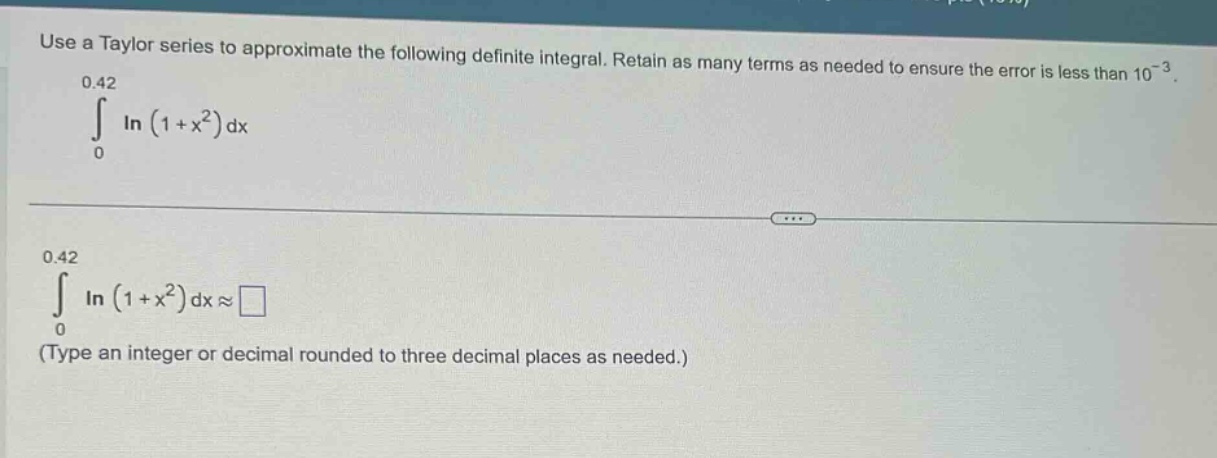
use a taylor series to approximate the following definite integral. retain as many terms as needed to ensure the error is less than 10^(-3).\n0.42\n∫ in (1 + x^2) dx\n0\n0.42\n∫ in (1 + x^2) dx ≈ \n0\n(type an integer or decimal rounded to three decimal places as needed.)
Answer
Explanation:
Step1: Recall Taylor - series of $\ln(1 + t)$
The Taylor - series of $\ln(1 + t)$ about $t = 0$ is $\ln(1 + t)=\sum_{n = 1}^{\infty}\frac{(- 1)^{n+1}}{n}t^{n}=t-\frac{t^{2}}{2}+\frac{t^{3}}{3}-\frac{t^{4}}{4}+\cdots$. Let $t=x^{2}$, then $\ln(1 + x^{2})=\sum_{n = 1}^{\infty}\frac{(-1)^{n + 1}}{n}(x^{2})^{n}=\sum_{n = 1}^{\infty}\frac{(-1)^{n+1}}{n}x^{2n}=x^{2}-\frac{x^{4}}{2}+\frac{x^{6}}{3}-\frac{x^{8}}{4}+\cdots$.
Step2: Integrate the Taylor - series term - by - term
$\int_{0}^{0.42}\ln(1 + x^{2})dx=\int_{0}^{0.42}\sum_{n = 1}^{\infty}\frac{(-1)^{n + 1}}{n}x^{2n}dx=\sum_{n = 1}^{\infty}\frac{(-1)^{n+1}}{n}\int_{0}^{0.42}x^{2n}dx$. Since $\int_{0}^{0.42}x^{2n}dx=\left[\frac{x^{2n + 1}}{2n+1}\right]{0}^{0.42}=\frac{(0.42)^{2n+1}}{2n + 1}$, then $\int{0}^{0.42}\ln(1 + x^{2})dx=\sum_{n = 1}^{\infty}\frac{(-1)^{n+1}}{n}\cdot\frac{(0.42)^{2n+1}}{2n+1}$.
Step3: Calculate the sum of the series to meet the error requirement
For $n = 1$: $\frac{(-1)^{1 + 1}}{1}\cdot\frac{(0.42)^{2\times1+1}}{2\times1+1}=\frac{(0.42)^{3}}{3}=\frac{0.074088}{3}\approx0.0247$. For $n = 2$: $\frac{(-1)^{2 + 1}}{2}\cdot\frac{(0.42)^{2\times2+1}}{2\times2+1}=-\frac{(0.42)^{5}}{10}=-\frac{0.0130691232}{10}\approx - 0.00131$. For $n = 3$: $\frac{(-1)^{3+1}}{3}\cdot\frac{(0.42)^{2\times3 + 1}}{2\times3+1}=\frac{(0.42)^{7}}{21}\approx\frac{0.002352737}{21}\approx0.000112$. The sum $S\approx0.0247-0.00131 + 0.000112=0.023502\approx0.024$.
Answer:
$0.024$