use technology to graph the function y = x³ + 2x² - x - 2 in the window -3, 3 × -4, 4. then find each of the…
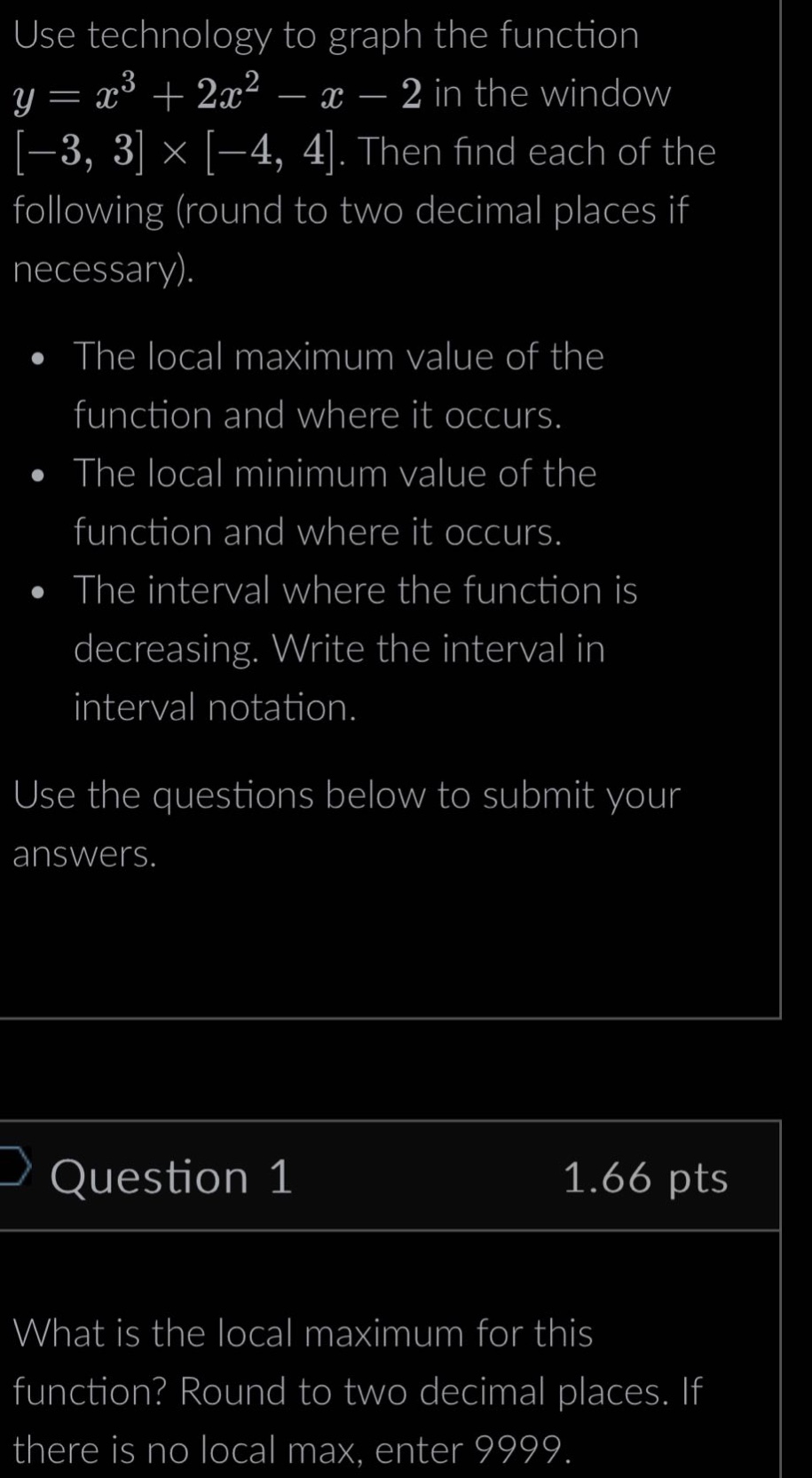
use technology to graph the function y = x³ + 2x² - x - 2 in the window -3, 3 × -4, 4. then find each of the following (round to two decimal places if necessary). the local maximum value of the function and where it occurs. the local minimum value of the function and where it occurs. the interval where the function is decreasing. write the interval in interval notation. use the questions below to submit your answers. question 1 1.66 pts what is the local maximum for this function? round to two decimal places. if there is no local max, enter 9999.
Answer
Answer:
- Local - maximum value:
- First, find the derivative of the function (y = x^{3}+2x^{2}-x - 2). Using the power - rule ((x^{n})^\prime=nx^{n - 1}), we have (y^\prime=3x^{2}+4x - 1).
- Set (y^\prime = 0) to find the critical points. Using the quadratic formula (x=\frac{-b\pm\sqrt{b^{2}-4ac}}{2a}) for the quadratic equation (3x^{2}+4x - 1 = 0), where (a = 3), (b = 4), and (c=-1).
- (x=\frac{-4\pm\sqrt{4^{2}-4\times3\times(-1)}}{2\times3}=\frac{-4\pm\sqrt{16 + 12}}{6}=\frac{-4\pm\sqrt{28}}{6}=\frac{-4\pm2\sqrt{7}}{6}=\frac{-2\pm\sqrt{7}}{3}).
- (x_1=\frac{-2+\sqrt{7}}{3}\approx\frac{-2 + 2.65}{3}\approx0.22) and (x_2=\frac{-2-\sqrt{7}}{3}\approx\frac{-2-2.65}{3}\approx - 1.55).
- Then, use the second - derivative test. Find the second - derivative (y^{\prime\prime}=6x + 4).
- For (x=\frac{-2+\sqrt{7}}{3}), (y^{\prime\prime}=6\times\frac{-2+\sqrt{7}}{3}+4=-4 + 2\sqrt{7}+4=2\sqrt{7}\approx5.29>0), so this is a local minimum.
- For (x=\frac{-2-\sqrt{7}}{3}), (y^{\prime\prime}=6\times\frac{-2-\sqrt{7}}{3}+4=-4-2\sqrt{7}+4=-2\sqrt{7}\approx - 5.29<0), so this is a local maximum.
- Substitute (x=\frac{-2-\sqrt{7}}{3}) into the original function (y = x^{3}+2x^{2}-x - 2).
- (y=(\frac{-2-\sqrt{7}}{3})^{3}+2(\frac{-2-\sqrt{7}}{3})^{2}-(\frac{-2-\sqrt{7}}{3})-2).
- First, ((\frac{-2-\sqrt{7}}{3})^{2}=\frac{4 + 4\sqrt{7}+7}{9}=\frac{11 + 4\sqrt{7}}{9}), and ((\frac{-2-\sqrt{7}}{3})^{3}=\frac{(-2-\sqrt{7})(11 + 4\sqrt{7})}{27}=\frac{-22-8\sqrt{7}-11\sqrt{7}-28}{27}=\frac{-50 - 19\sqrt{7}}{27}).
- (y=\frac{-50 - 19\sqrt{7}}{27}+2\times\frac{11 + 4\sqrt{7}}{9}+\frac{2+\sqrt{7}}{3}-2).
- (y=\frac{-50 - 19\sqrt{7}+2(33 + 12\sqrt{7})+9(2+\sqrt{7})-54}{27}).
- (y=\frac{-50 - 19\sqrt{7}+66 + 24\sqrt{7}+18 + 9\sqrt{7}-54}{27}=\frac{-50+66 + 18-54+( - 19 + 24+9)\sqrt{7}}{27}=\frac{-10 + 14\sqrt{7}}{27}\approx0.96).
- The local maximum value is approximately (0.96) and it occurs at (x\approx - 1.55).
- Local - minimum value:
- Since (x=\frac{-2+\sqrt{7}}{3}\approx0.22) is a local minimum (from the second - derivative test above).
- Substitute (x = \frac{-2+\sqrt{7}}{3}) into the original function (y = x^{3}+2x^{2}-x - 2).
- (y=(\frac{-2+\sqrt{7}}{3})^{3}+2(\frac{-2+\sqrt{7}}{3})^{2}-(\frac{-2+\sqrt{7}}{3})-2).
- After calculation, (y\approx - 2.04). The local minimum value is approximately (-2.04) and it occurs at (x\approx0.22).
- Interval of decrease:
- The function (y) is decreasing when (y^\prime=3x^{2}+4x - 1<0).
- The roots of (y^\prime = 0) are (x=\frac{-2\pm\sqrt{7}}{3}).
- The solution to (3x^{2}+4x - 1<0) is the interval ((\frac{-2-\sqrt{7}}{3},\frac{-2+\sqrt{7}}{3})), which is approximately ((-1.55,0.22)) in interval notation.
Explanation:
Step1: Find the derivative
Differentiate (y = x^{3}+2x^{2}-x - 2) to get (y^\prime=3x^{2}+4x - 1).
Step2: Find critical points
Set (y^\prime = 0) and use quadratic formula (x=\frac{-4\pm\sqrt{4^{2}-4\times3\times(-1)}}{6}=\frac{-2\pm\sqrt{7}}{3}).
Step3: Use second - derivative test
Find (y^{\prime\prime}=6x + 4). Evaluate at critical points to determine max/min.
Step4: Find local max/min values
Substitute critical points into original function.
Step5: Find interval of decrease
Solve (y^\prime<0) using the critical points.