use transformations of the graph of f(x)=e^x to graph the given function. be sure to give the equation of…
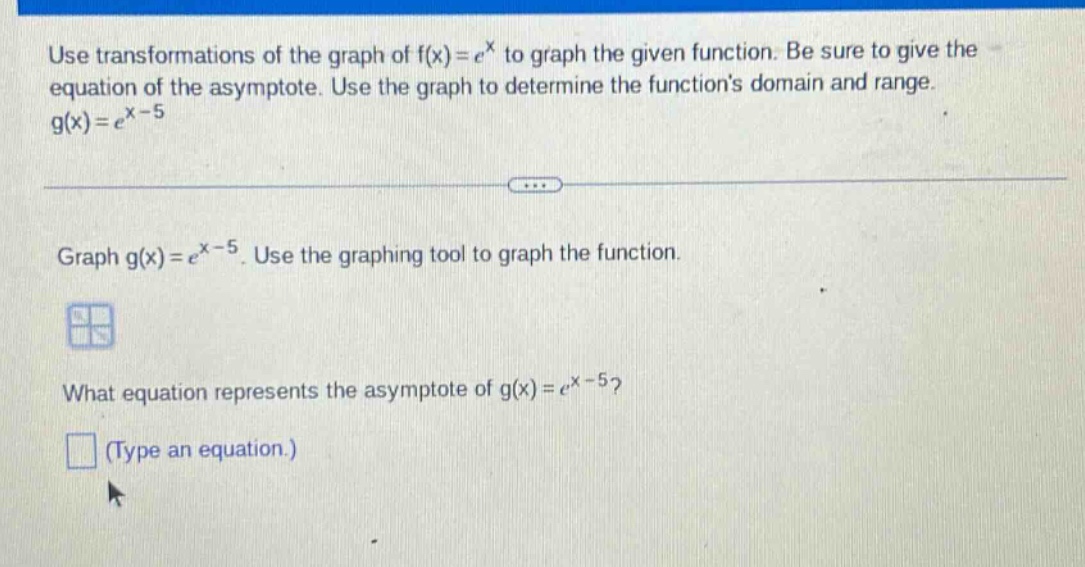
use transformations of the graph of f(x)=e^x to graph the given function. be sure to give the equation of the asymptote. use the graph to determine the functions domain and range. g(x)=e^x - 5 graph g(x)=e^x - 5. use the graphing tool to graph the function. what equation represents the asymptote of g(x)=e^x - 5? (type an equation.)
Answer
Explanation:
Step1: Recall parent - function properties
The parent function $f(x)=e^{x}$ has a horizontal asymptote at $y = 0$, domain $(-\infty,\infty)$ and range $(0,\infty)$.
Step2: Analyze the transformation
The function $g(x)=e^{x - 5}$ is a horizontal shift of the function $f(x)=e^{x}$ to the right by 5 units. The horizontal asymptote of an exponential function of the form $y = a\cdot e^{x - h}+k$ (in our case $a = 1$, $h = 5$, $k = 0$) is not affected by horizontal shifts. So the horizontal asymptote of $g(x)=e^{x - 5}$ is $y = 0$. The domain of an exponential function is not affected by horizontal shifts. So the domain of $g(x)$ is $(-\infty,\infty)$. The range of an exponential function of the form $y=e^{x - h}$ is the same as the range of $y = e^{x}$ since the vertical position is not changed. So the range of $g(x)$ is $(0,\infty)$.
Answer:
Asymptote: $y = 0$ Domain: $(-\infty,\infty)$ Range: $(0,\infty)$