use transformations of the graph of f(x)=e^x to graph the given function. be sure to give the equation of…
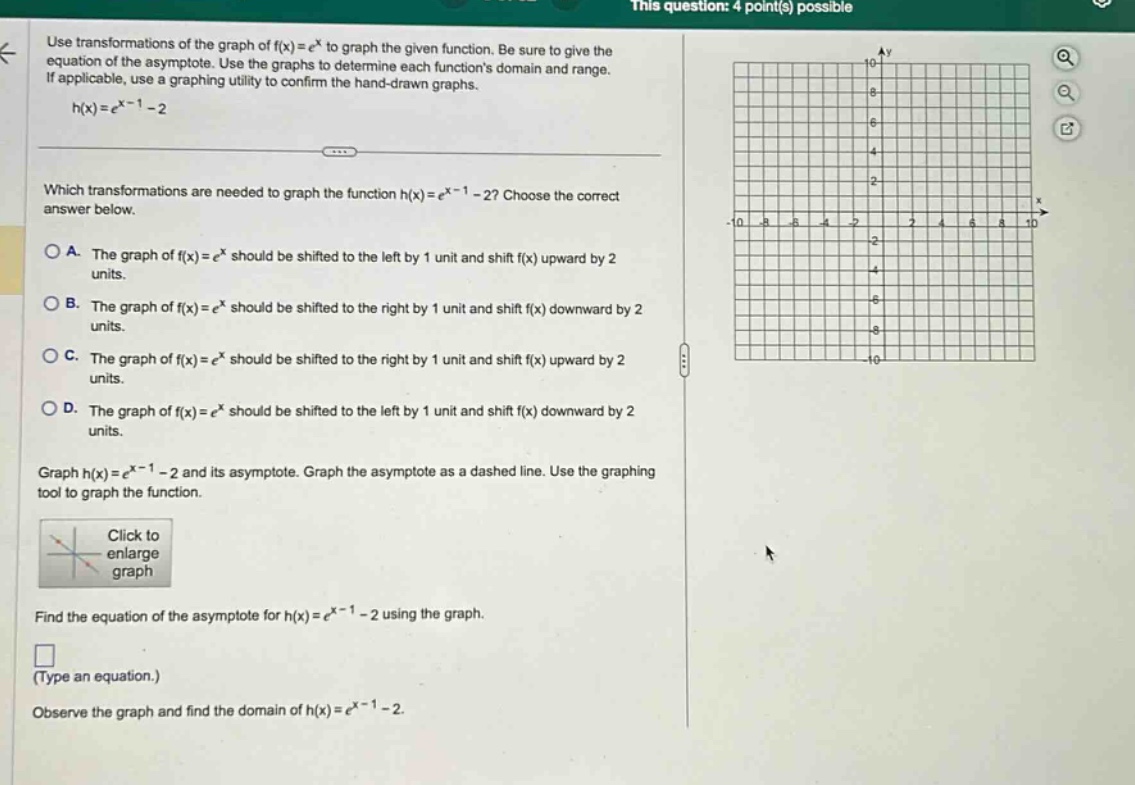
use transformations of the graph of f(x)=e^x to graph the given function. be sure to give the equation of the asymptote. use the graphs to determine each functions domain and range. if applicable, use a graphing utility to confirm the hand - drawn graphs. h(x)=e^(x - 1)-2 which transformations are needed to graph the function h(x)=e^(x - 1)-2? choose the correct answer below. a. the graph of f(x)=e^x should be shifted to the left by 1 unit and shift f(x) upward by 2 units. b. the graph of f(x)=e^x should be shifted to the right by 1 unit and shift f(x) downward by 2 units. c. the graph of f(x)=e^x should be shifted to the right by 1 unit and shift f(x) upward by 2 units. d. the graph of f(x)=e^x should be shifted to the left by 1 unit and shift f(x) downward by 2 units. graph h(x)=e^(x - 1)-2 and its asymptote. graph the asymptote as a dashed line. use the graphing tool to graph the function. click to enlarge graph find the equation of the asymptote for h(x)=e^(x - 1)-2 using the graph. (type an equation.) observe the graph and find the domain of h(x)=e^(x - 1)-2.
Answer
Explanation:
Step1: Recall transformation rules
For a function $y = f(x - a)+b$, the graph of $y = f(x)$ is shifted right by $a$ units and up by $b$ units. For the function $h(x)=e^{x - 1}-2$, comparing with $y = f(x - a)+b$ where $f(x)=e^{x}$, $a = 1$ and $b=- 2$.
Step2: Determine the transformation
Since $a = 1$, the graph of $f(x)=e^{x}$ is shifted to the right by 1 unit. Since $b=-2$, the graph of $f(x)$ is shifted downward by 2 units.
Step3: Find the asymptote
The parent - function $y = e^{x}$ has an asymptote $y = 0$. When we transform $y = e^{x}$ to $y=e^{x - 1}-2$, the asymptote also shifts. The new asymptote is $y=-2$.
Step4: Determine the domain
The exponential function $y = e^{x}$ has a domain of all real numbers. Transformations do not change the domain of an exponential function. So the domain of $h(x)=e^{x - 1}-2$ is $(-\infty,\infty)$.
Answer:
- B. The graph of $f(x)=e^{x}$ should be shifted to the right by 1 unit and shift $f(x)$ downward by 2 units.
- The equation of the asymptote is $y = - 2$.
- The domain of $h(x)$ is $(-\infty,\infty)$.