use transformations of the graph of f(x)=e^x to graph the given function. be sure to give equations of the…
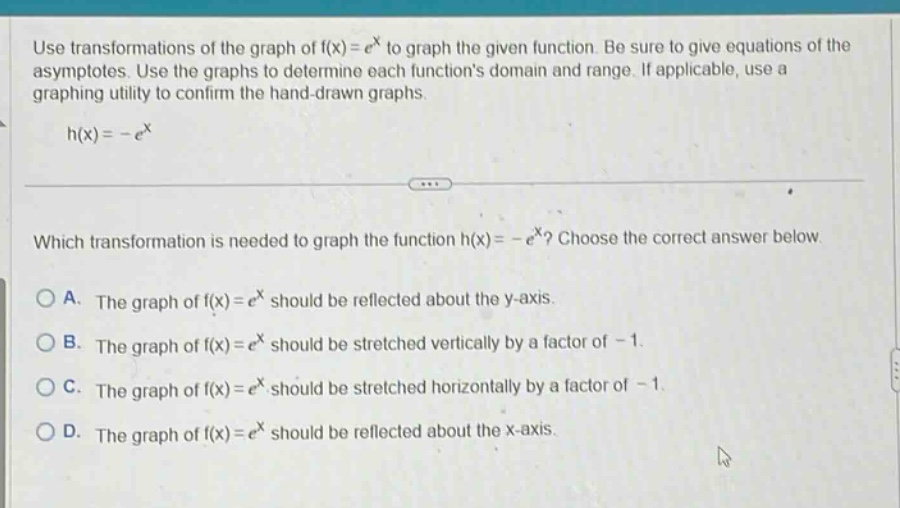
use transformations of the graph of f(x)=e^x to graph the given function. be sure to give equations of the asymptotes. use the graphs to determine each functions domain and range. if applicable, use a graphing utility to confirm the hand - drawn graphs. h(x)=-e^x which transformation is needed to graph the function h(x)=-e^x? choose the correct answer below. a. the graph of f(x)=e^x should be reflected about the y - axis. b. the graph of f(x)=e^x should be stretched vertically by a factor of - 1. c. the graph of f(x)=e^x should be stretched horizontally by a factor of - 1. d. the graph of f(x)=e^x should be reflected about the x - axis.
Answer
Brief Explanations:
For a function (y = f(x)), changing it to (y=-f(x)) reflects the graph of (y = f(x)) about the x - axis. Here (f(x)=e^{x}) and (h(x)=-e^{x}), so the graph of (f(x)=e^{x}) is reflected about the x - axis to get the graph of (h(x)=-e^{x}).
Answer:
D. The graph of (f(x)=e^{x}) should be reflected about the x - axis.