use transformations of the graph of (f(x)=3^{x}) to graph the given function. be sure to graph and give the…
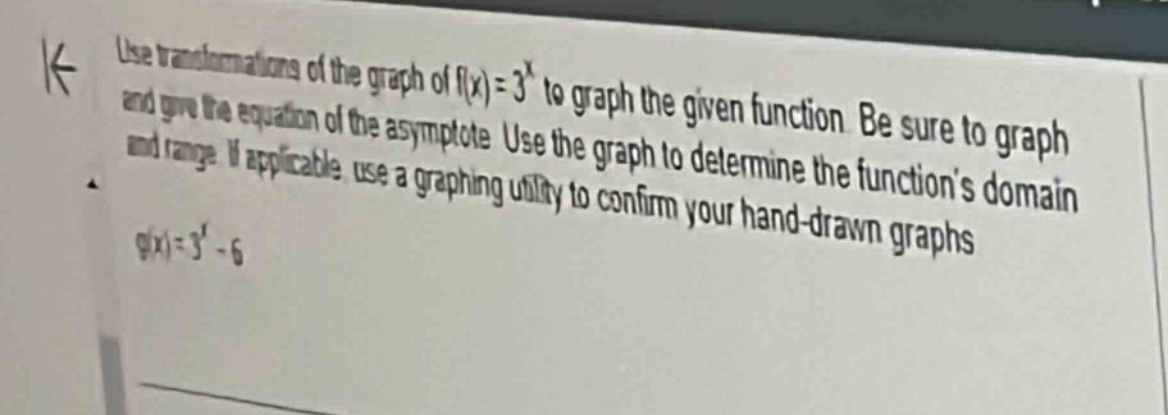
use transformations of the graph of (f(x)=3^{x}) to graph the given function. be sure to graph and give the equation of the asymptote. use the graph to determine the functions domain and range. if applicable, use a graphing utility to confirm your hand - drawn graphs.\ng(x)=3^{x}-6
Answer
Explanation:
Step1: Recall the properties of $y = 3^x$
The function $y = 3^x$ has a horizontal - asymptote at $y = 0$, domain $(-\infty,\infty)$ and range $(0,\infty)$.
Step2: Analyze the transformation of $g(x)=3^x - 6$
The function $g(x)=3^x - 6$ is a vertical shift of the function $y = 3^x$ down by 6 units.
Step3: Find the asymptote
For the function $g(x)=3^x - 6$, the horizontal asymptote is $y=-6$ because the entire graph of $y = 3^x$ is shifted down 6 units.
Step4: Determine the domain
The domain of an exponential function of the form $y = a^x + k$ (where $a>0,a\neq1$ and $k$ is a real - number) is the set of all real numbers. So, the domain of $g(x)=3^x - 6$ is $(-\infty,\infty)$.
Step5: Determine the range
Since the range of $y = 3^x$ is $(0,\infty)$ and we shift it down 6 units, the range of $g(x)$ is $(-6,\infty)$.
Answer:
Asymptote: $y = - 6$; Domain: $(-\infty,\infty)$; Range: $(-6,\infty)$