use www.desmos.com to graph the following functions. copy and paste the graph (screenshot) find the…
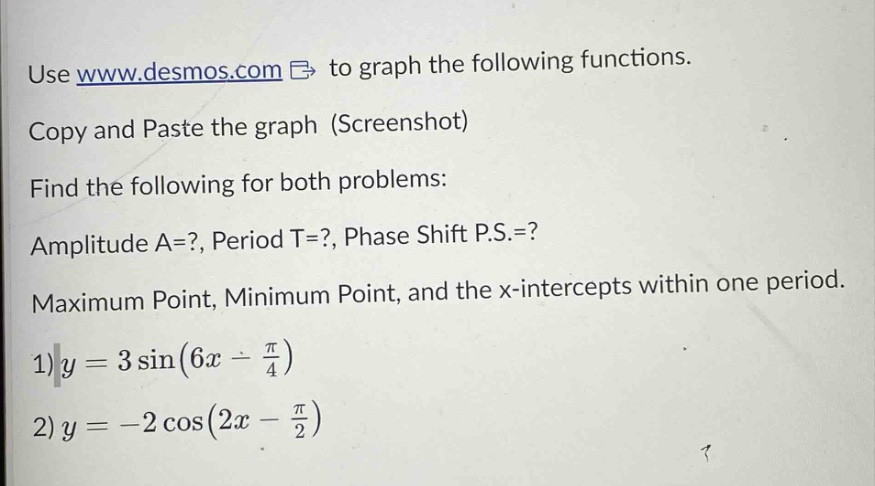
use www.desmos.com to graph the following functions. copy and paste the graph (screenshot) find the following for both problems: amplitude a=?, period t=?, phase shift p.s.=? maximum point, minimum point, and the x - intercepts within one period. 1)y = 3 sin(6x - π/4) 2)y = -2 cos(2x - π/2)
Answer
Explanation:
Step1: Recall sine - function formula
For a sine function (y = A\sin(Bx - C)), the amplitude (A) is given by (|A|), the period (T=\frac{2\pi}{|B|}), and the phase - shift (P.S.=\frac{C}{B}). For (y = 3\sin(6x-\frac{\pi}{4})), (A = 3), (B = 6), (C=\frac{\pi}{4}).
Step2: Calculate amplitude
(A=|3| = 3)
Step3: Calculate period
(T=\frac{2\pi}{|6|}=\frac{\pi}{3})
Step4: Calculate phase - shift
(P.S.=\frac{\frac{\pi}{4}}{6}=\frac{\pi}{24})
Step5: Find maximum and minimum points
The maximum value of (y = 3\sin(6x-\frac{\pi}{4})) occurs when (\sin(6x-\frac{\pi}{4}) = 1). (6x-\frac{\pi}{4}=\frac{\pi}{2}+2k\pi,k\in\mathbb{Z}), (6x=\frac{3\pi}{4}+2k\pi), (x=\frac{\pi}{8}+\frac{k\pi}{3}). In one period ((k = 0)), the maximum point is ((\frac{\pi}{8},3)). The minimum value occurs when (\sin(6x - \frac{\pi}{4})=-1). (6x-\frac{\pi}{4}=-\frac{\pi}{2}+2k\pi,k\in\mathbb{Z}), (6x=-\frac{\pi}{4}+2k\pi), (x =-\frac{\pi}{24}+\frac{k\pi}{3}). In one period ((k = 0)), the minimum point is ((-\frac{\pi}{24}, - 3)).
Step6: Find x - intercepts
Set (y = 0), then (\sin(6x-\frac{\pi}{4})=0), (6x-\frac{\pi}{4}=k\pi,k\in\mathbb{Z}), (6x=k\pi+\frac{\pi}{4}), (x=\frac{k\pi}{6}+\frac{\pi}{24}). In one period ((k = 0)), (x=\frac{\pi}{24}); (k = 1), (x=\frac{5\pi}{24}).
For the cosine function (y=-2\cos(2x - \frac{\pi}{2})), where (A=-2), (B = 2), (C=\frac{\pi}{2}).
Step7: Calculate amplitude
(A = |-2|=2)
Step8: Calculate period
(T=\frac{2\pi}{|2|}=\pi)
Step9: Calculate phase - shift
(P.S.=\frac{\frac{\pi}{2}}{2}=\frac{\pi}{4})
Step10: Find maximum and minimum points
The maximum value of (y=-2\cos(2x - \frac{\pi}{2})) occurs when (\cos(2x - \frac{\pi}{2})=-1). (2x-\frac{\pi}{2}=\pi + 2k\pi,k\in\mathbb{Z}), (2x=\frac{3\pi}{2}+2k\pi), (x=\frac{3\pi}{4}+k\pi). In one period ((k = 0)), the maximum point is ((\frac{3\pi}{4},2)). The minimum value occurs when (\cos(2x - \frac{\pi}{2}) = 1). (2x-\frac{\pi}{2}=2k\pi,k\in\mathbb{Z}), (2x=\frac{\pi}{2}+2k\pi), (x=\frac{\pi}{4}+k\pi). In one period ((k = 0)), the minimum point is ((\frac{\pi}{4},-2)).
Step11: Find x - intercepts
Set (y = 0), then (\cos(2x-\frac{\pi}{2}) = 0), (2x-\frac{\pi}{2}=\frac{\pi}{2}+k\pi,k\in\mathbb{Z}), (2x=\pi + k\pi), (x=\frac{\pi}{2}+\frac{k\pi}{2}). In one period ((k = 0)), (x=\frac{\pi}{2}); (k = 1), (x=\pi).
Answer:
- For (y = 3\sin(6x-\frac{\pi}{4})):
- Amplitude (A = 3)
- Period (T=\frac{\pi}{3})
- Phase - shift (P.S.=\frac{\pi}{24})
- Maximum point: ((\frac{\pi}{8},3))
- Minimum point: ((-\frac{\pi}{24},-3))
- x - intercepts in one period: (x=\frac{\pi}{24},\frac{5\pi}{24})
- For (y=-2\cos(2x - \frac{\pi}{2})):
- Amplitude (A = 2)
- Period (T=\pi)
- Phase - shift (P.S.=\frac{\pi}{4})
- Maximum point: ((\frac{3\pi}{4},2))
- Minimum point: ((\frac{\pi}{4},-2))
- x - intercepts in one period: (x=\frac{\pi}{2},\pi)