use what you know about translations of functions to analyze the graph of the function $f(x)=(0.5)^{x…
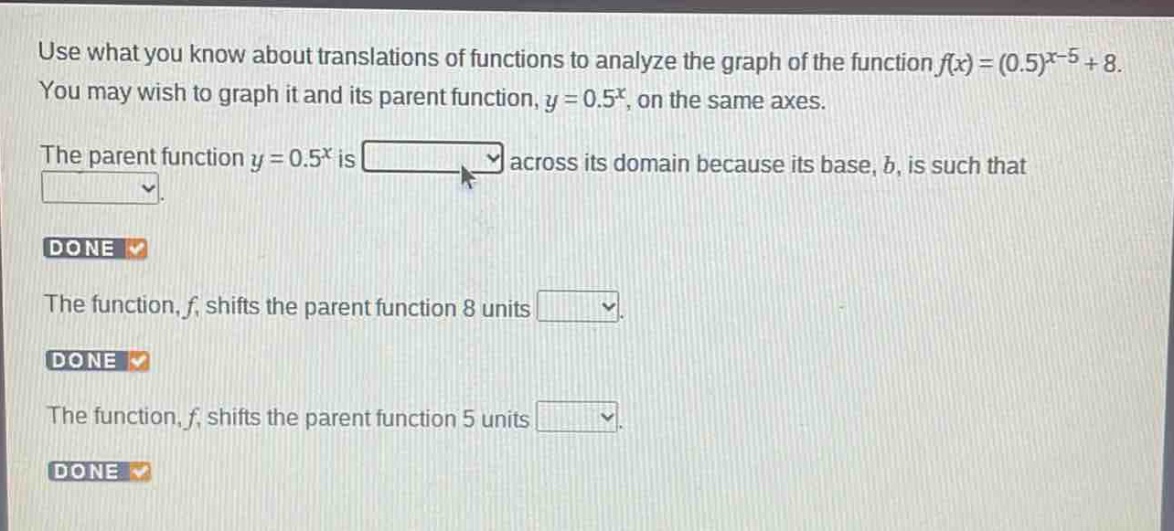
use what you know about translations of functions to analyze the graph of the function $f(x)=(0.5)^{x - 5}+8$. you may wish to graph it and its parent function, $y = 0.5^{x}$, on the same axes. the parent function $y = 0.5^{x}$ is across its domain because its base, $b$, is such that. done the function, $f$, shifts the parent function 8 units. done the function, $f$, shifts the parent function 5 units. done
Answer
Explanation:
Step1: Analyze the base of the parent - function
For an exponential function $y = b^x$, when $0 < b<1$, the function is decreasing. Here, $b = 0.5$ and $0<0.5 < 1$, so the parent function $y = 0.5^x$ is decreasing across its domain.
Step2: Analyze the vertical shift
For a function of the form $y=f(x)+k$, if $k>0$, the graph of the function is shifted $k$ units up. In the function $f(x)=(0.5)^{x - 5}+8$, since $k = 8>0$, the function $f$ shifts the parent function 8 units up.
Step3: Analyze the horizontal shift
For a function of the form $y = f(x - h)$, if $h>0$, the graph of the function is shifted $h$ units to the right. In the function $f(x)=(0.5)^{x - 5}+8$, since $h = 5>0$, the function $f$ shifts the parent function 5 units to the right.
Answer:
The parent function $y = 0.5^x$ is decreasing across its domain because its base, $b$, is such that $0 < b<1$. The function, $f$, shifts the parent function 8 units up. The function, $f$, shifts the parent function 5 units to the right.