using the binomial series with k = -1/2 and with x replaced by - x/9, we have the following. 1/sqrt(9 - x) =…
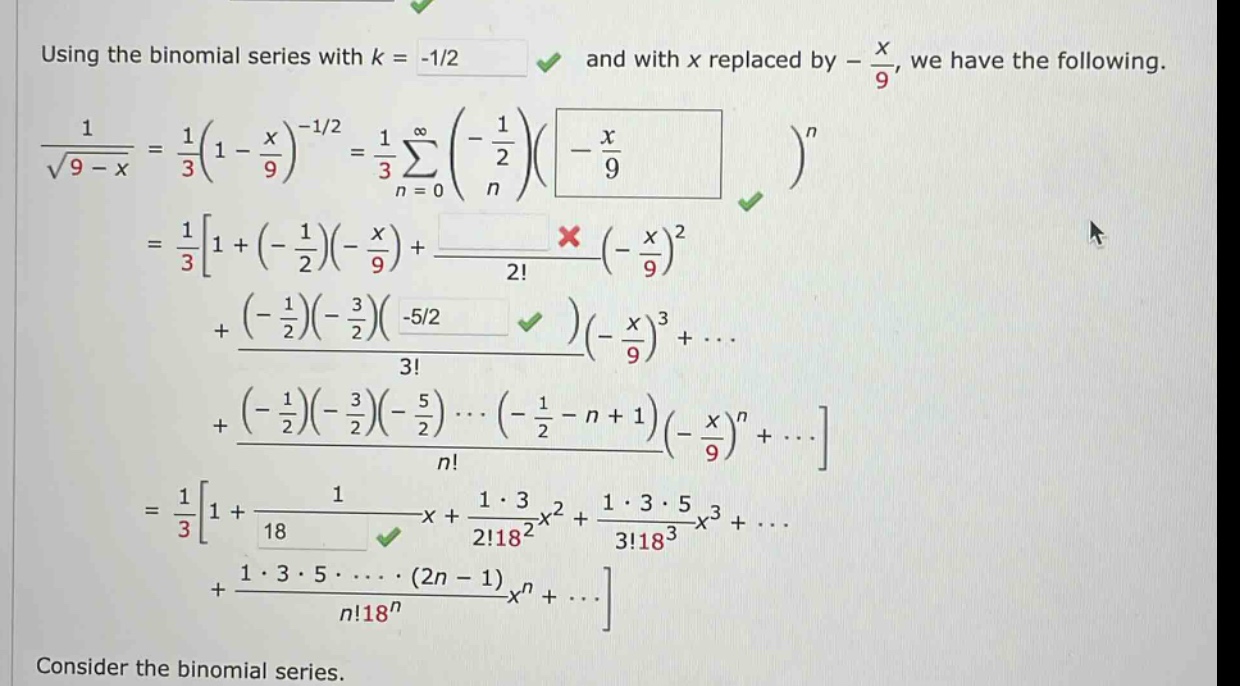
using the binomial series with k = -1/2 and with x replaced by - x/9, we have the following. 1/sqrt(9 - x) = 1/3(1 - x/9)^(-1/2) = 1/3 sum(n = 0 to infinity) ((-1/2)/n) ((-x/9))^n = 1/31 + (-1/2)(-x/9) + (-x/9)^2/2! + ((-1/2)(-3/2)(-5/2)/3!) (-x/9)^3 + ... + ((-1/2)(-3/2)(-5/2) ... (-1/2 - n + 1)/n!) (-x/9)^n + ... = 1/31 + 1/18 x + 1 * 3/(2!18^2)x^2 + 1 * 3 * 5/(3!18^3)x^3 + ... + 1 * 3 * 5 * ... * (2n - 1)/(n!18^n)x^n + ... consider the binomial series.
Answer
Explanation:
Step1: Recall binomial - series formula
The binomial - series formula for $(1 + y)^k=\sum_{n = 0}^{\infty}\binom{k}{n}y^{n}$, where $\binom{k}{n}=\frac{k(k - 1)\cdots(k - n+1)}{n!}$. Here, we have $\frac{1}{\sqrt{9 - x}}=\frac{1}{3}(1-\frac{x}{9})^{-\frac{1}{2}}$, with $k =-\frac{1}{2}$ and $y=-\frac{x}{9}$.
Step2: Expand the binomial - series
\begin{align*} \frac{1}{3}(1-\frac{x}{9})^{-\frac{1}{2}}&=\frac{1}{3}\sum_{n = 0}^{\infty}\binom{-\frac{1}{2}}{n}(-\frac{x}{9})^{n}\ &=\frac{1}{3}\left[1+\left(-\frac{1}{2}\right)\left(-\frac{x}{9}\right)+\frac{\left(-\frac{1}{2}\right)\left(-\frac{3}{2}\right)}{2!}\left(-\frac{x}{9}\right)^{2}+\frac{\left(-\frac{1}{2}\right)\left(-\frac{3}{2}\right)\left(-\frac{5}{2}\right)}{3!}\left(-\frac{x}{9}\right)^{3}+\cdots+\frac{\left(-\frac{1}{2}\right)\left(-\frac{3}{2}\right)\cdots\left(-\frac{1}{2}-n + 1\right)}{n!}\left(-\frac{x}{9}\right)^{n}+\cdots\right] \end{align*}
Step3: Simplify the coefficients
- For the first - order term: $\left(-\frac{1}{2}\right)\left(-\frac{x}{9}\right)=\frac{1}{18}x$.
- For the second - order term: $\frac{\left(-\frac{1}{2}\right)\left(-\frac{3}{2}\right)}{2!}\left(-\frac{x}{9}\right)^{2}=\frac{1\times3}{2!}\times\frac{1}{18^{2}}x^{2}$.
- For the third - order term: $\frac{\left(-\frac{1}{2}\right)\left(-\frac{3}{2}\right)\left(-\frac{5}{2}\right)}{3!}\left(-\frac{x}{9}\right)^{3}=\frac{1\times3\times5}{3!}\times\frac{1}{18^{3}}x^{3}$.
- In general, for the $n$th - order term: $\frac{\left(-\frac{1}{2}\right)\left(-\frac{3}{2}\right)\cdots\left(-\frac{1}{2}-n + 1\right)}{n!}\left(-\frac{x}{9}\right)^{n}=\frac{1\times3\times5\times\cdots\times(2n - 1)}{n!}\times\frac{1}{18^{n}}x^{n}$.
So, $\frac{1}{\sqrt{9 - x}}=\frac{1}{3}\left[1+\frac{1}{18}x+\frac{1\times3}{2!18^{2}}x^{2}+\frac{1\times3\times5}{3!18^{3}}x^{3}+\cdots+\frac{1\times3\times5\times\cdots\times(2n - 1)}{n!18^{n}}x^{n}+\cdots\right]$.
Answer:
$\frac{1}{\sqrt{9 - x}}=\frac{1}{3}\sum_{n = 0}^{\infty}\frac{1\times3\times5\times\cdots\times(2n - 1)}{n!18^{n}}x^{n}$