using the definition of the derivative, find f(x). then find f(1), f(2), and f(3) when the derivative…
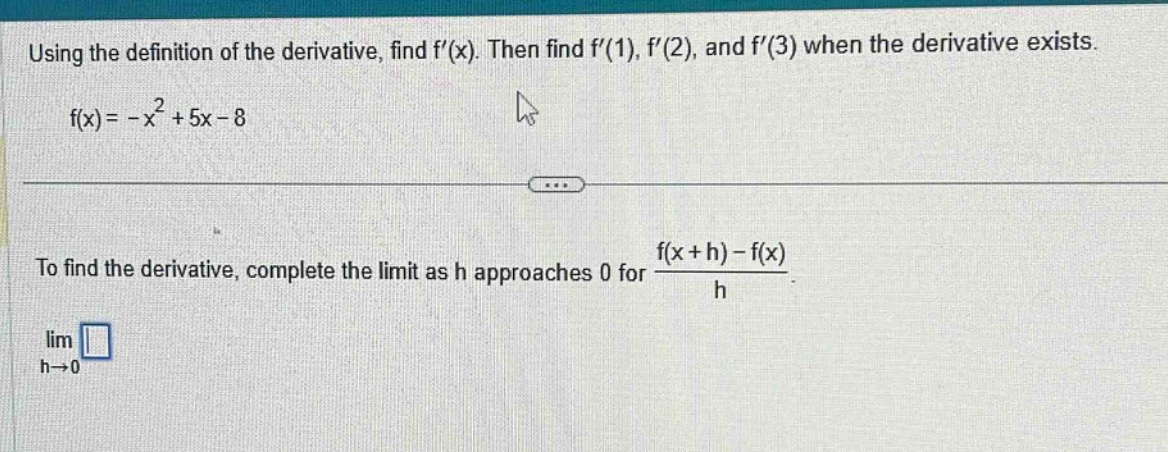
using the definition of the derivative, find f(x). then find f(1), f(2), and f(3) when the derivative exists. f(x)= -x² + 5x - 8 to find the derivative, complete the limit as h approaches 0 for (f(x + h)-f(x))/h. lim h→0
Answer
Explanation:
Step1: Find f(x + h)
[ \begin{align*} f(x + h)&=-(x + h)^2+5(x + h)-8\ &=-(x^{2}+2xh+h^{2})+5x + 5h-8\ &=-x^{2}-2xh - h^{2}+5x + 5h-8 \end{align*} ]
Step2: Calculate f(x + h) - f(x)
[ \begin{align*} f(x + h)-f(x)&=(-x^{2}-2xh - h^{2}+5x + 5h-8)-(-x^{2}+5x - 8)\ &=-x^{2}-2xh - h^{2}+5x + 5h-8 + x^{2}-5x + 8\ &=-2xh - h^{2}+5h \end{align*} ]
Step3: Calculate (\frac{f(x + h)-f(x)}{h})
[ \begin{align*} \frac{f(x + h)-f(x)}{h}&=\frac{-2xh - h^{2}+5h}{h}\ &=-2x - h+5 \end{align*} ]
Step4: Find the limit as h approaches 0
[ \begin{align*} f'(x)&=\lim_{h\rightarrow0}\frac{f(x + h)-f(x)}{h}\ &=\lim_{h\rightarrow0}(-2x - h+5)\ &=-2x+5 \end{align*} ]
Step5: Find f'(1)
[ f'(1)=-2\times1 + 5=3 ]
Step6: Find f'(2)
[ f'(2)=-2\times2 + 5=1 ]
Step7: Find f'(3)
[ f'(3)=-2\times3 + 5=-1 ]
Answer:
(f'(x)=-2x + 5), (f'(1)=3), (f'(2)=1), (f'(3)=-1)