using the graph, determine any relative maxima or minima of the function and the intervals on which the…
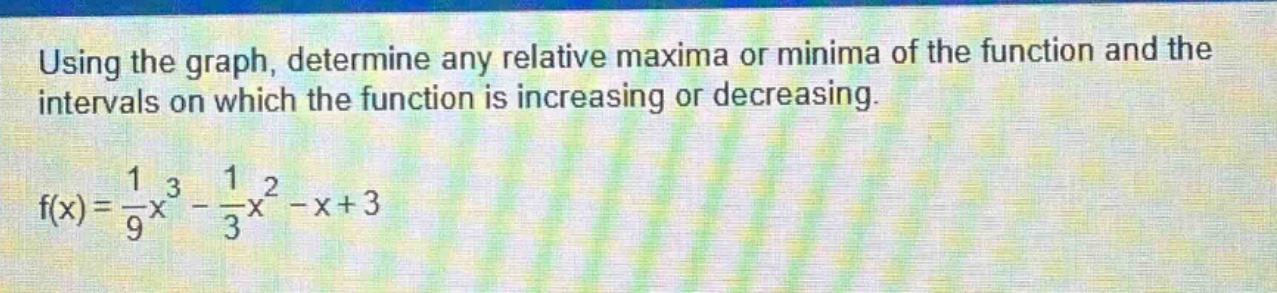
using the graph, determine any relative maxima or minima of the function and the intervals on which the function is increasing or decreasing. f(x)=1/9x^3 - 1/3x^2 - x + 3
Answer
Explanation:
Step1: Find the derivative
Differentiate $f(x)=\frac{1}{9}x^{3}-\frac{1}{3}x^{2}-x + 3$ using the power - rule. The derivative $f'(x)=\frac{1}{9}\times3x^{2}-\frac{1}{3}\times2x-1=\frac{1}{3}x^{2}-\frac{2}{3}x - 1$.
Step2: Set the derivative equal to zero
Set $f'(x) = 0$, so $\frac{1}{3}x^{2}-\frac{2}{3}x - 1=0$. Multiply through by 3 to get $x^{2}-2x - 3 = 0$. Factor the quadratic equation: $(x - 3)(x+1)=0$. Solving for $x$, we get $x=-1$ and $x = 3$.
Step3: Use the first - derivative test
Choose test points in the intervals $(-\infty,-1)$, $(-1,3)$ and $(3,\infty)$. For the interval $(-\infty,-1)$, let $x=-2$. Then $f'(-2)=\frac{1}{3}\times(-2)^{2}-\frac{2}{3}\times(-2)-1=\frac{4}{3}+\frac{4}{3}-1=\frac{4 + 4-3}{3}=\frac{5}{3}>0$, so the function is increasing on $(-\infty,-1)$. For the interval $(-1,3)$, let $x = 0$. Then $f'(0)=\frac{1}{3}\times0^{2}-\frac{2}{3}\times0-1=-1<0$, so the function is decreasing on $(-1,3)$. For the interval $(3,\infty)$, let $x = 4$. Then $f'(4)=\frac{1}{3}\times4^{2}-\frac{2}{3}\times4-1=\frac{16}{3}-\frac{8}{3}-1=\frac{16 - 8-3}{3}=\frac{5}{3}>0$, so the function is increasing on $(3,\infty)$. Since the function changes from increasing to decreasing at $x=-1$, $f(-1)=\frac{1}{9}\times(-1)^{3}-\frac{1}{3}\times(-1)^{2}-(-1)+3=-\frac{1}{9}-\frac{1}{3}+1 + 3=-\frac{1}{9}-\frac{3}{9}+\frac{9}{9}+\frac{27}{9}=\frac{-1-3 + 9+27}{9}=\frac{32}{9}$ is a relative maximum. Since the function changes from decreasing to increasing at $x = 3$, $f(3)=\frac{1}{9}\times3^{3}-\frac{1}{3}\times3^{2}-3 + 3=1 - 3-3 + 3=-2$ is a relative minimum.
Answer:
Relative maximum: $f(-1)=\frac{32}{9}$; Relative minimum: $f(3)=-2$; Increasing intervals: $(-\infty,-1)$ and $(3,\infty)$; Decreasing interval: $(-1,3)$