using the graph, determine any relative maxima or minima of the function and the intervals on which the…
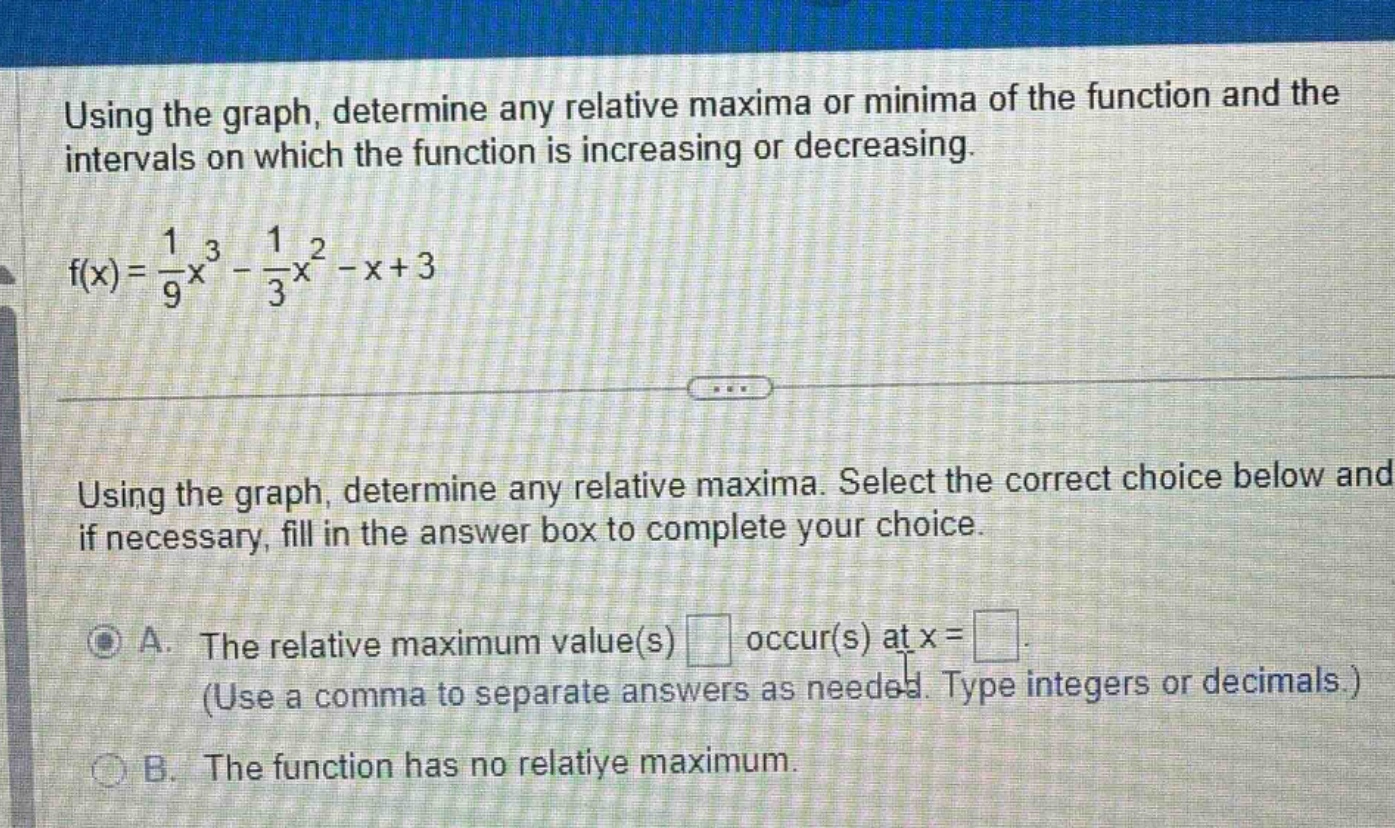
using the graph, determine any relative maxima or minima of the function and the intervals on which the function is increasing or decreasing. f(x)=1/9x^3 - 1/3x^2 - x + 3 using the graph, determine any relative maxima. select the correct choice below and if necessary, fill in the answer box to complete your choice. a. the relative maximum value(s) occur(s) at x= (use a comma to separate answers as needed. type integers or decimals.) b. the function has no relative maximum.
Answer
Explanation:
Step1: Find the derivative
Differentiate $f(x)=\frac{1}{9}x^{3}-\frac{1}{3}x^{2}-x + 3$ using the power - rule. The derivative $f^\prime(x)=\frac{1}{9}\times3x^{2}-\frac{1}{3}\times2x - 1=\frac{1}{3}x^{2}-\frac{2}{3}x - 1$.
Step2: Set the derivative equal to zero
Set $f^\prime(x)=0$, so $\frac{1}{3}x^{2}-\frac{2}{3}x - 1 = 0$. Multiply through by 3 to get $x^{2}-2x - 3=0$.
Step3: Factor the quadratic equation
Factor $x^{2}-2x - 3=(x - 3)(x+1)=0$.
Step4: Solve for x
Setting each factor equal to zero gives $x - 3=0$ or $x + 1=0$, so $x=-1$ or $x = 3$.
Step5: Use the second - derivative test
Find the second - derivative $f^{\prime\prime}(x)=\frac{2}{3}x-\frac{2}{3}$. Evaluate $f^{\prime\prime}(-1)=\frac{2}{3}\times(-1)-\frac{2}{3}=-\frac{4}{3}<0$, so $f(x)$ has a relative maximum at $x=-1$. Evaluate $f^{\prime\prime}(3)=\frac{2}{3}\times3-\frac{2}{3}=\frac{4}{3}>0$, so $f(x)$ has a relative minimum at $x = 3$.
Step6: Find the relative maximum value
Substitute $x=-1$ into $f(x)$: $f(-1)=\frac{1}{9}\times(-1)^{3}-\frac{1}{3}\times(-1)^{2}-(-1)+3=-\frac{1}{9}-\frac{1}{3}+1 + 3=-\frac{1}{9}-\frac{3}{9}+4=\frac{-1 - 3}{9}+4=\frac{-4}{9}+4=\frac{-4 + 36}{9}=\frac{32}{9}\approx3.56$.
Answer:
A. The relative maximum value(s) $\frac{32}{9}$ occur(s) at $x=-1$