using 1/(1 - r)=∑(n = 0)^∞ r^n, a power series representation of 1/(1 - t^12) is ∑(n = 0)^∞(t^12)^n. step 2…
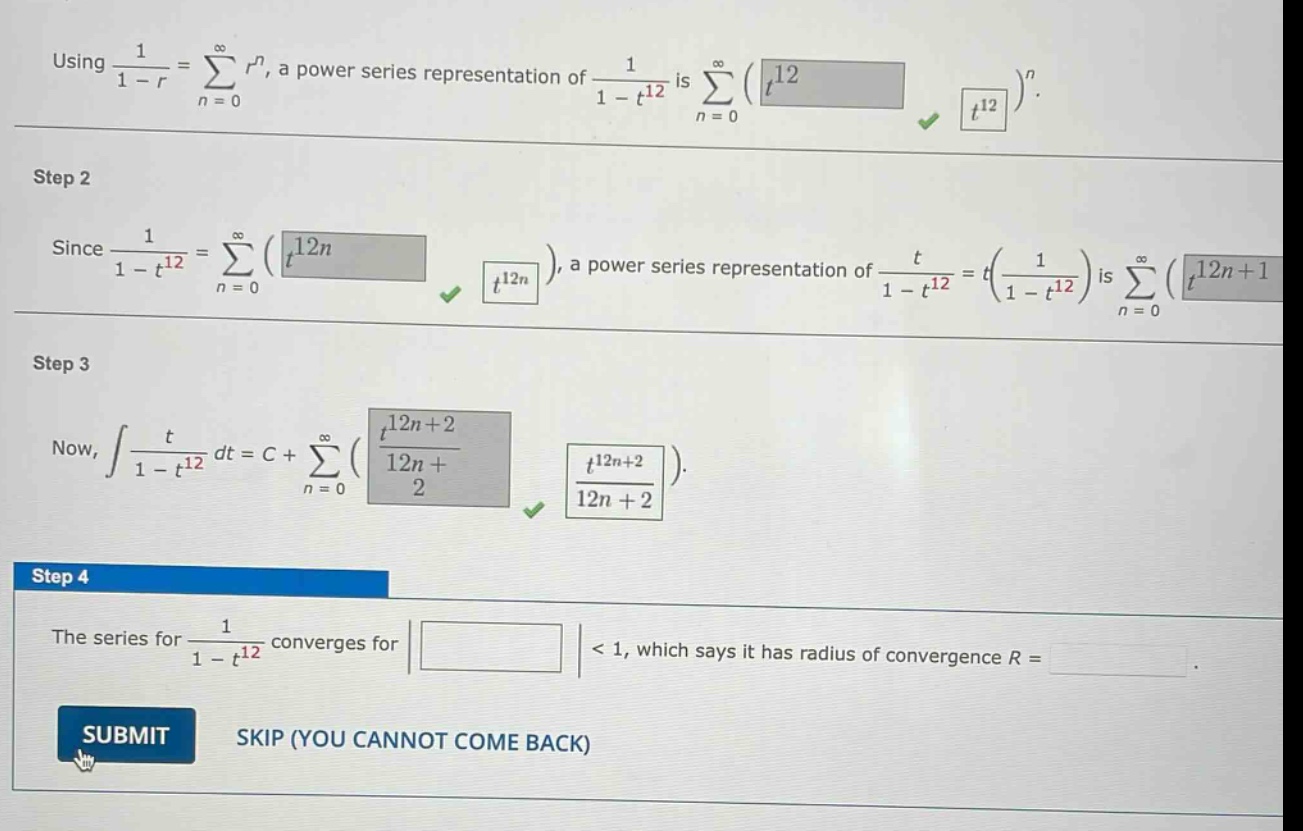
using 1/(1 - r)=∑(n = 0)^∞ r^n, a power series representation of 1/(1 - t^12) is ∑(n = 0)^∞(t^12)^n. step 2 since 1/(1 - t^12)=∑(n = 0)^∞(t^12n), a power series representation of t/(1 - t^12)=t(1/(1 - t^12)) is ∑(n = 0)^∞(t^12n + 1). step 3 now, ∫t/(1 - t^12)dt = c+∑(n = 0)^∞(t^12n + 2)/(12n + 2). step 4 the series for 1/(1 - t^12) converges for | | < 1, which says it has radius of convergence r = . submit skip (you cannot come back)
Answer
Explanation:
Step1: Recall geometric - series formula
The geometric - series formula is $\frac{1}{1 - r}=\sum_{n = 0}^{\infty}r^{n}$, which converges for $|r|\lt1$. For the function $\frac{1}{1 - t^{12}}$, we set $r=t^{12}$, so $\frac{1}{1 - t^{12}}=\sum_{n = 0}^{\infty}(t^{12})^{n}=\sum_{n = 0}^{\infty}t^{12n}$.
Step2: Multiply by $t$
We know that $\frac{t}{1 - t^{12}}=t\cdot\frac{1}{1 - t^{12}}$. Since $\frac{1}{1 - t^{12}}=\sum_{n = 0}^{\infty}t^{12n}$, then $\frac{t}{1 - t^{12}}=t\sum_{n = 0}^{\infty}t^{12n}=\sum_{n = 0}^{\infty}t^{12n + 1}$.
Step3: Integrate term - by - term
Integrating $\sum_{n = 0}^{\infty}t^{12n+1}$ with respect to $t$, we use the power - rule for integration $\int t^{m}dt=\frac{t^{m + 1}}{m+1}+C$ ($m\neq - 1$). So $\int\frac{t}{1 - t^{12}}dt=C+\sum_{n = 0}^{\infty}\frac{t^{12n + 2}}{12n+2}$.
Step4: Find the radius of convergence
For the geometric series $\frac{1}{1 - r}=\sum_{n = 0}^{\infty}r^{n}$, it converges when $|r|\lt1$. In our case, $r = t^{12}$, so the series $\frac{1}{1 - t^{12}}=\sum_{n = 0}^{\infty}(t^{12})^{n}$ converges when $|t^{12}|\lt1$. Since $|t^{12}|=|t|^{12}$, then $|t|^{12}\lt1$, which implies $|t|\lt1$.
Answer:
$|t^{12}|$, $1$