using only the values given in the table for the function, $f(x)=x^{3}-3x - 2$, what is the interval of x…
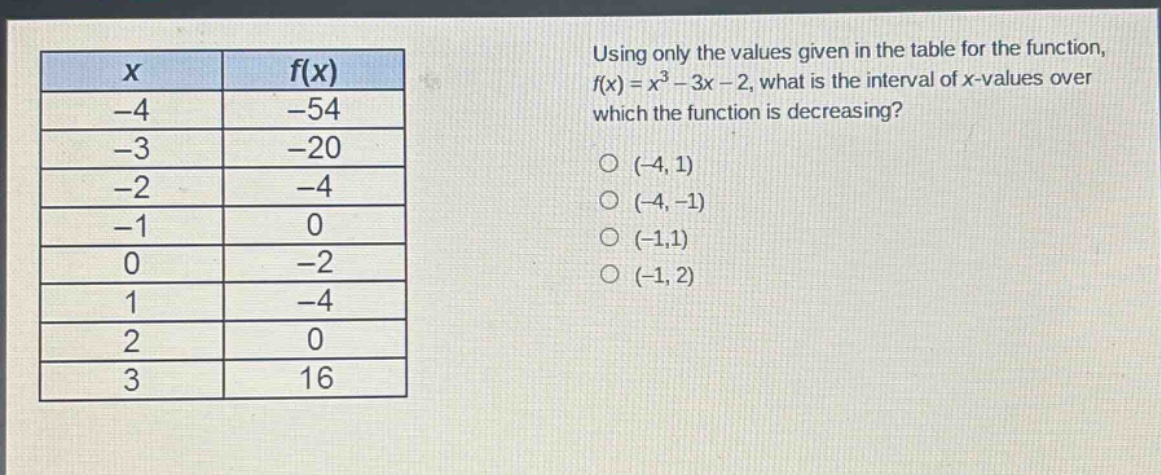
using only the values given in the table for the function, $f(x)=x^{3}-3x - 2$, what is the interval of x - values over which the function is decreasing?\n(-4,1)\n(-4,-1)\n(-1,1)\n(-1,2)\n\nx\tf(x)\n-4\t-54\n-3\t-20\n-2\t-4\n-1\t0\n0\t-2\n1\t-4\n2\t0\n3\t16
Answer
Explanation:
Step1: Check function values
A function is decreasing when as $x$ increases, $f(x)$ decreases.
Step2: Analyze intervals
For the interval $(-4,-1)$: when $x$ goes from $- 4$ to $-1$, $f(x)$ goes from $-54$ to $0$ (increases). For the interval $(-4,1)$: when $x$ goes from $-4$ to $-1$ it increases and from $-1$ to $1$ it decreases. For the interval $(-1,1)$: as $x$ increases from $-1$ to $1$, $f(x)$ goes from $0$ to $-4$, so $f(x)$ is decreasing. For the interval $(-1,2)$: as $x$ goes from $1$ to $2$, $f(x)$ goes from $-4$ to $0$ (increases).
Answer:
C. $(-1,1)$