using only the values given in the table for the function, $f(x)=x^{3}-3x - 2$, what is the interval of x…
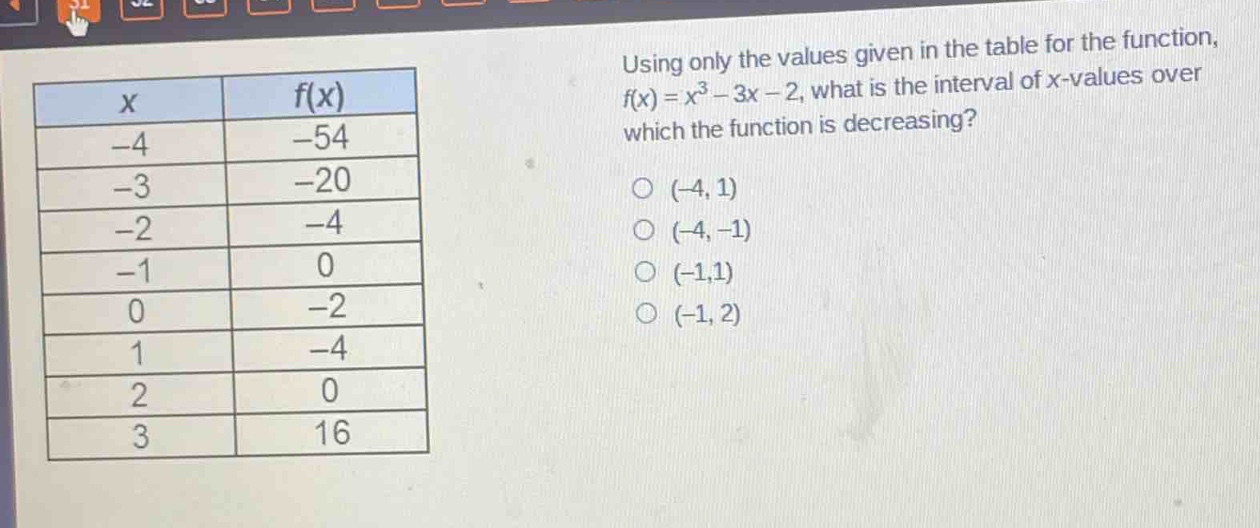
using only the values given in the table for the function, $f(x)=x^{3}-3x - 2$, what is the interval of x - values over which the function is decreasing?\n(-4,1)\n(-4,-1)\n(-1,1)\n(-1,2)\n\n| x | f(x) |\n| -4 | -54 |\n| -3 | -20 |\n| -2 | -4 |\n| -1 | 0 |\n| 0 | -2 |\n| 1 | -4 |\n| 2 | 0 |\n| 3 | 16 |
Answer
Explanation:
Step1: Recall decreasing - function property
A function $y = f(x)$ is decreasing when $f(x_1)>f(x_2)$ for $x_1 < x_2$.
Step2: Check intervals from the table
For the interval $(-4,1)$: When $x=-4$, $f(-4)=-54$; when $x = - 3$, $f(-3)=-20$; when $x=-2$, $f(-2)=-4$; when $x=-1$, $f(-1)=0$; when $x = 0$, $f(0)=-2$; when $x = 1$, $f(1)=-4$. The function is not always decreasing on $(-4,1)$. For the interval $(-4,-1)$: When $x=-4$, $f(-4)=-54$; when $x=-3$, $f(-3)=-20$; when $x=-2$, $f(-2)=-4$; when $x=-1$, $f(-1)=0$. The function is increasing on part of this interval. For the interval $(-1,1)$: When $x=-1$, $f(-1)=0$; when $x = 0$, $f(0)=-2$; when $x = 1$, $f(1)=-4$. Since $f(-1)>f(0)>f(1)$, the function is decreasing on the interval $(-1,1)$. For the interval $(-1,2)$: When $x=-1$, $f(-1)=0$; when $x = 0$, $f(0)=-2$; when $x = 1$, $f(1)=-4$; when $x = 2$, $f(2)=0$. The function is not always decreasing on $(-1,2)$.
Answer:
C. $(-1,1)$