using only the values given in the table for the function, ( f(x) ), what is the interval of ( x )-values…
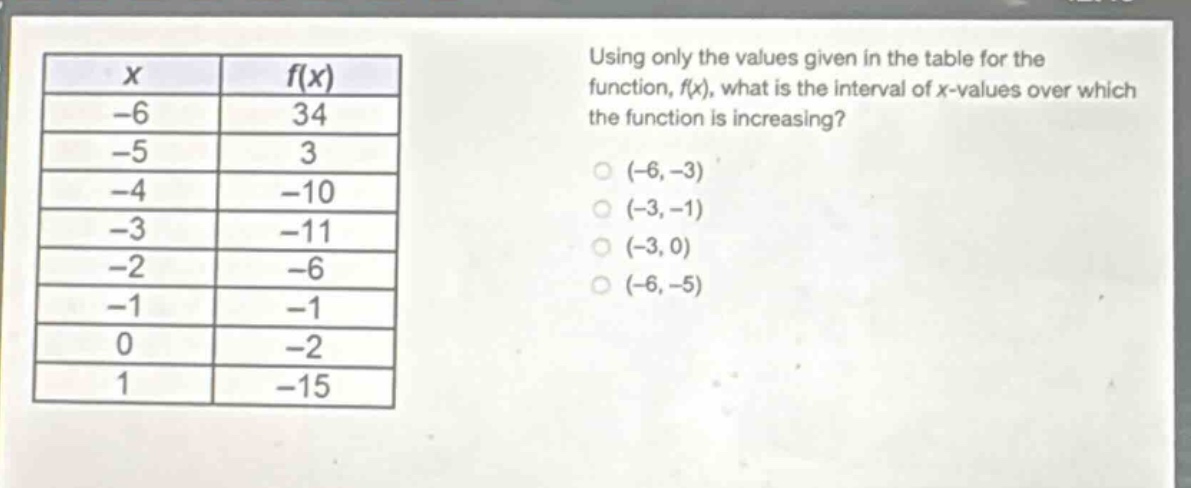
using only the values given in the table for the function, ( f(x) ), what is the interval of ( x )-values over which the function is increasing?\n( (-6,-3) )\n( (-3,-1) )\n( (-3,0) )\n( (-6,-5) )
Answer
Explanation:
Step1: Understand the concept of an increasing function
A function (y = f(x)) is increasing on an interval if, for any two values (x_1) and (x_2) in the interval with (x_1<x_2), we have (f(x_1)<f(x_2)).
Step2: Check each interval
- For the interval ((-6,-3)):
- When (x=-6), (f(x) = 34); when (x=-5), (f(x)=3); when (x = -4), (f(x)=-10); when (x=-3), (f(x)=-11). Since (34>3>-10>-11), the function is decreasing on ((-6,-3)).
- For the interval ((-3,-1)):
- When (x=-3), (f(x)=-11); when (x=-2), (f(x)=-6); when (x=-1), (f(x)=-1). Since (-11<-6<-1), the function is increasing on ((-3,-1)).
- For the interval ((-3,0)):
- When (x=-3), (f(x)=-11); when (x=-2), (f(x)=-6); when (x=-1), (f(x)=-1); when (x = 0), (f(x)=-2). Since (-11<-6<-1) but (-1>-2), the function is not increasing on ((-3,0)).
- For the interval ((-6,-5)):
- When (x=-6), (f(x) = 34); when (x=-5), (f(x)=3). Since (34>3), the function is decreasing on ((-6,-5)).
Answer:
((-3,-1))