which is a valid prediction about the continuous function f(x)?\n○ f(x) ≥ 0 over the interval 5, ∞).\n○ f(x)…
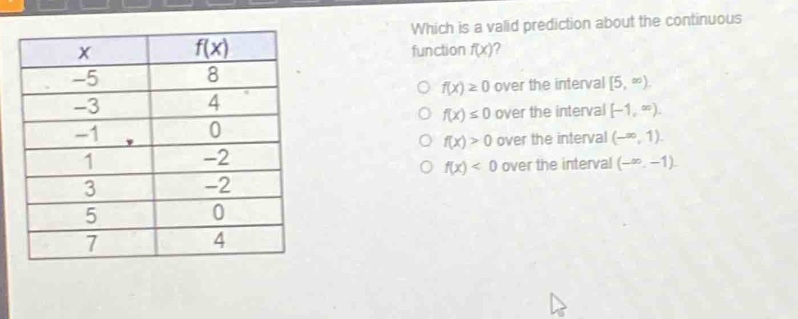
which is a valid prediction about the continuous function f(x)?\n○ f(x) ≥ 0 over the interval 5, ∞).\n○ f(x) ≤ 0 over the interval -1, ∞).\n○ f(x) > 0 over the interval (-∞, 1).\n○ f(x) < 0 over the interval (-∞, -1).\n\nx\tf(x)\n-5\t8\n-3\t4\n-1\t0\n1\t-2\n3\t-2\n5\t0\n7\t4
Answer
Explanation:
Step1: Analyze the sign of f(x) in each interval
We have the following points: (-5, 8), (-3, 4), (-1, 0), (1, -2), (3, -2), (5, 0), (7, 4).
Step2: Check the first option
For the interval $[5,\infty)$, when $x = 5$, $f(5)=0$ and when $x = 7$, $f(7)=4>0$. Since the function is continuous, $f(x)\geq0$ over the interval $[5,\infty)$.
Step3: Check the second option
For the interval $[-1,\infty)$, when $x = 1$, $f(1)=-2<0$ and when $x = 7$, $f(7)=4>0$, so $f(x)\leq0$ is not true over $[-1,\infty)$.
Step4: Check the third option
For the interval $(-\infty,1)$, when $x=-1$, $f(-1) = 0$, so $f(x)>0$ is not true over $(-\infty,1)$.
Step5: Check the fourth option
For the interval $(-\infty,-1)$, when $x=-5$, $f(-5)=8>0$, so $f(x)<0$ is not true over $(-\infty,-1)$.
Answer:
$f(x)\geq0$ over the interval $[5,\infty)$