which is a valid prediction about the continuous function f(x)?\n○ f(x) ≥ 0 over the interval 5, ∞).\n○ f(x)…
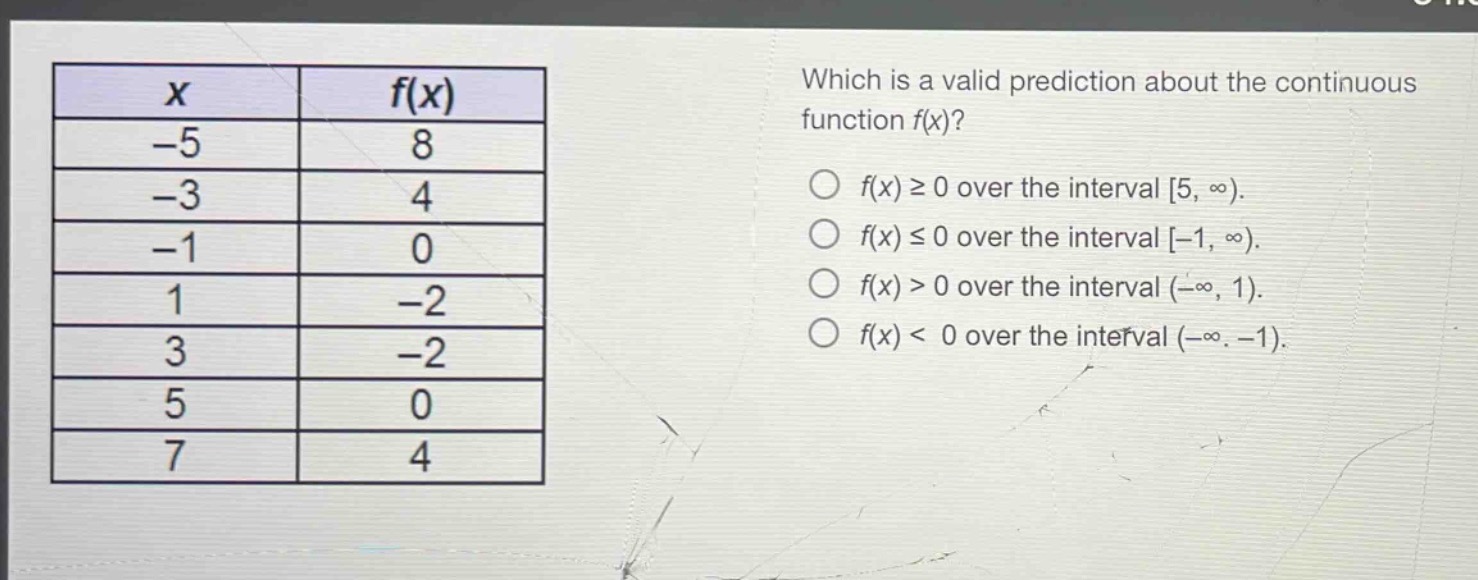
which is a valid prediction about the continuous function f(x)?\n○ f(x) ≥ 0 over the interval 5, ∞).\n○ f(x) ≤ 0 over the interval -1, ∞).\n○ f(x) > 0 over the interval (-∞, 1).\n○ f(x) < 0 over the interval (-∞, -1).\n\n| x | f(x) |\n| -5 | 8 |\n| -3 | 4 |\n| -1 | 0 |\n| 1 | -2 |\n| 3 | -2 |\n| 5 | 0 |\n| 7 | 4 |
Answer
Explanation:
Step1: Analyze option A
We have data points. For (x = 5), (f(5)=0) and for (x = 7), (f(7) = 4>0). Since the function is continuous, for (x\geq5), (f(x)\geq0).
Step2: Analyze option B
At (x = 7), (f(7)=4>0), so (f(x)\leq0) over ([- 1,\infty)) is false.
Step3: Analyze option C
At (x=-1), (f(-1) = 0), so (f(x)>0) over ((-\infty,1)) is false.
Step4: Analyze option D
At (x=-5), (f(-5)=8>0), so (f(x)<0) over ((-\infty,-1)) is false.
Answer:
(f(x)\geq0) over the interval ([5,\infty))