valuate f and these polynomials at x = π/4, π/2, and π. (round your answers to four decimal places.) comment…
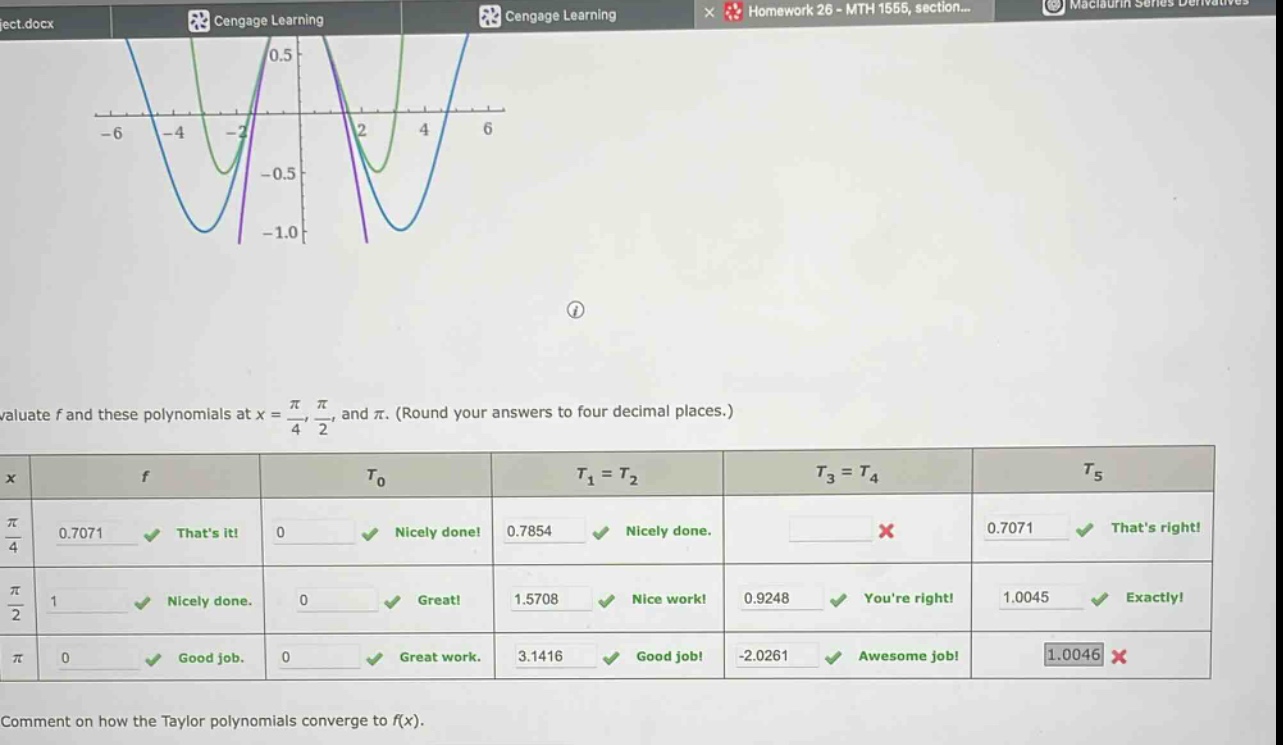
valuate f and these polynomials at x = π/4, π/2, and π. (round your answers to four decimal places.) comment on how the taylor polynomials converge to f(x).
Answer
Explanation:
Step1: Recall Taylor - series concept
The Taylor series of a function (f(x)) about (x = a) is given by (f(x)=\sum_{n = 0}^{\infty}\frac{f^{(n)}(a)}{n!}(x - a)^n=T_0+T_1+T_2+\cdots), where (T_n=\frac{f^{(n)}(a)}{n!}(x - a)^n). The Taylor polynomials (T_k(x)=\sum_{n = 0}^{k}\frac{f^{(n)}(a)}{n!}(x - a)^n) are partial - sums of the Taylor series.
Step2: Analyze convergence
As (k) (the degree of the Taylor polynomial) increases, the Taylor polynomials (T_k(x)) generally get closer to the function (f(x)) in an interval around the point of expansion. In this case, as we move from (T_0) (a constant polynomial) to higher - degree polynomials (T_1,T_2,\cdots,T_5), we can observe that for values of (x) close to the point of expansion (not given explicitly in the problem but assumed to be relevant), the values of the Taylor polynomials approach the values of (f(x)). For example, at (x=\frac{\pi}{4}), (T_5) gives a value very close to (f(\frac{\pi}{4})). At (x = \frac{\pi}{2}) and (x=\pi), higher - degree polynomials also show better approximation to (f(x)) compared to lower - degree ones.
Answer:
As the degree of the Taylor polynomials increases, they converge to (f(x)) in an interval around the point of expansion, and the approximations at (x=\frac{\pi}{4},\frac{\pi}{2},\pi) get more accurate as the degree of the Taylor polynomial increases.