value: 2 use the unit circle to find cos⁻¹(-√3/2) in radians. remember that the domain of inverse cosine is…
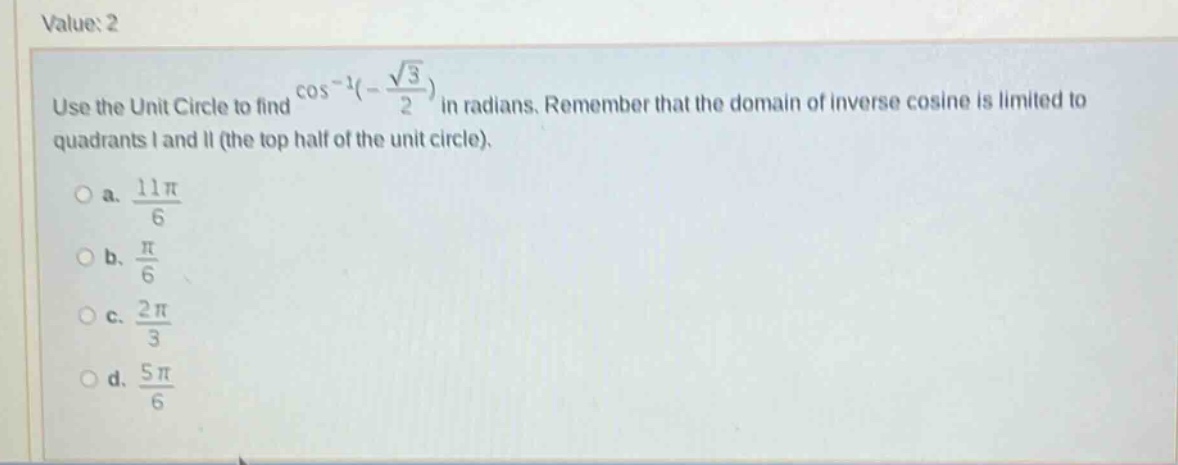
value: 2 use the unit circle to find cos⁻¹(-√3/2) in radians. remember that the domain of inverse cosine is limited to quadrants i and ii (the top half of the unit circle). a. 11π/6 b. π/6 c. 2π/3 d. 5π/6
Answer
Explanation:
Step1: Recall cosine - unit circle relationship
We know that $\cos\theta=x$ on the unit - circle, where $(x,y)$ is a point on the unit - circle and $\theta$ is the angle measured counter - clockwise from the positive $x$ - axis. We need to find $\theta$ such that $\cos\theta =-\frac{\sqrt{3}}{2}$ and $0\leq\theta\leq\pi$.
Step2: Analyze cosine values in quadrants I and II
In the unit - circle, $\cos\frac{\pi}{6}=\frac{\sqrt{3}}{2}$. Since we want $\cos\theta =-\frac{\sqrt{3}}{2}$ and the cosine function is negative in the second quadrant ($\frac{\pi}{2}<\theta\leq\pi$), and we know that $\cos(\pi - \alpha)=-\cos\alpha$. Let $\alpha=\frac{\pi}{6}$, then $\cos(\pi-\frac{\pi}{6})=\cos\frac{5\pi}{6}=-\frac{\sqrt{3}}{2}$.
Answer:
D. $\frac{5\pi}{6}$