values of a function v(t) are given in table.\nanswer the following questions:\na. what is the largest…
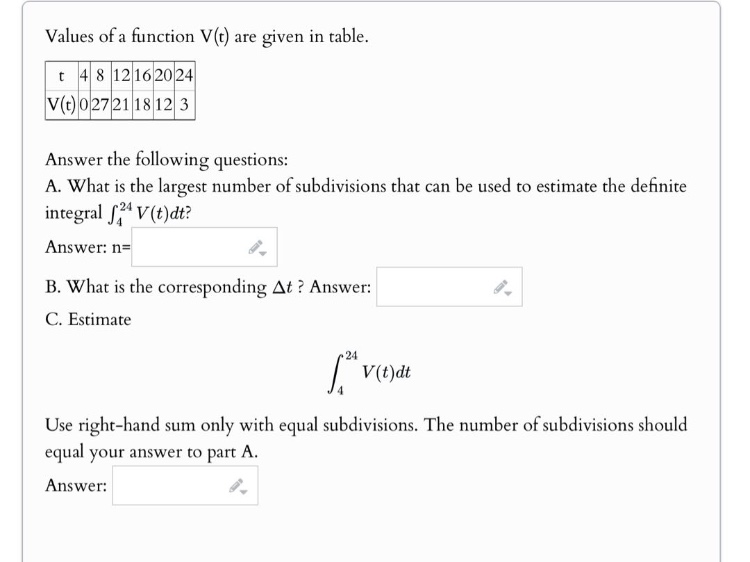
values of a function v(t) are given in table.\nanswer the following questions:\na. what is the largest number of subdivisions that can be used to estimate the definite integral ∫₄²⁴ v(t)dt?\nanswer: n=\n\nb. what is the corresponding δt? answer:\n\nc. estimate\n∫₄²⁴ v(t)dt\nuse right - hand sum only with equal subdivisions. the number of subdivisions should equal your answer to part a.\nanswer:
Answer
Explanation:
Step1: Determine number of subdivisions
The number of data - points is 6. The number of subdivisions $n$ for a definite integral estimation using a table of values is one less than the number of data - points. So, $n = 5$.
Step2: Calculate $\Delta t$
The formula for $\Delta t=\frac{b - a}{n}$, where $a = 4$, $b = 24$ and $n = 5$. So, $\Delta t=\frac{24 - 4}{5}=\frac{20}{5}=4$.
Step3: Calculate right - hand sum
The right - hand sum formula for $\int_{a}^{b}V(t)dt\approx\sum_{i = 1}^{n}V(t_{i})\Delta t$. Here, $a = 4$, $b = 24$, $n = 5$, $\Delta t=4$, and the right - hand values of $V(t)$ for the 5 subintervals are $V(8)=27$, $V(12)=21$, $V(16)=18$, $V(20)=12$, $V(24)=3$. [ \begin{align*} \sum_{i = 1}^{5}V(t_{i})\Delta t&=4\times(27 + 21+18 + 12+3)\ &=4\times(81)\ &=324 \end{align*} ]
Answer:
A. 5 B. 4 C. 324