for what values of a and m does f(x) have a horizontal asymptote at y = 2 and a vertical asymptote at x =…
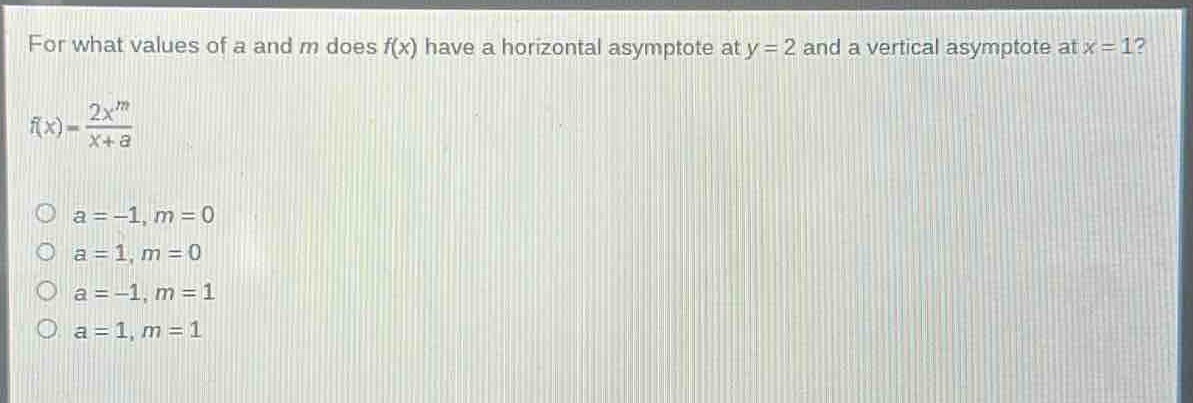
for what values of a and m does f(x) have a horizontal asymptote at y = 2 and a vertical asymptote at x = 1?\n$f(x)=\frac{2x^{m}}{x + a}$\no a=-1, m = 0\no a = 1, m = 0\no a=-1, m = 1\no a = 1, m = 1
Answer
Explanation:
Step1: Find the vertical - asymptote
The vertical asymptote of a rational function $y = \frac{f(x)}{g(x)}$ occurs at the values of $x$ for which $g(x)=0$. For the function $f(x)=\frac{2x^{m}}{x + a}$, setting $x + a=0$ gives $x=-a$. Since the vertical asymptote is at $x = 1$, we have $-a=1$, so $a=-1$.
Step2: Find the horizontal - asymptote
Case 1: If $m = 0$, then $f(x)=\frac{2x^{0}}{x - 1}=\frac{2}{x - 1}$. As $x\to\pm\infty$, $\lim_{x\to\pm\infty}\frac{2}{x - 1}=0$. Case 2: If $m = 1$, then $f(x)=\frac{2x}{x - 1}$. We can rewrite it as $f(x)=\frac{2x-2 + 2}{x - 1}=2+\frac{2}{x - 1}$. As $x\to\pm\infty$, $\lim_{x\to\pm\infty}(2+\frac{2}{x - 1})=2$.
Answer:
C. $a=-1, m = 1$