what values of a and b make the function f continuous on the interval\nf(x)=\begin{cases}\frac{x^{2}-4}{x…
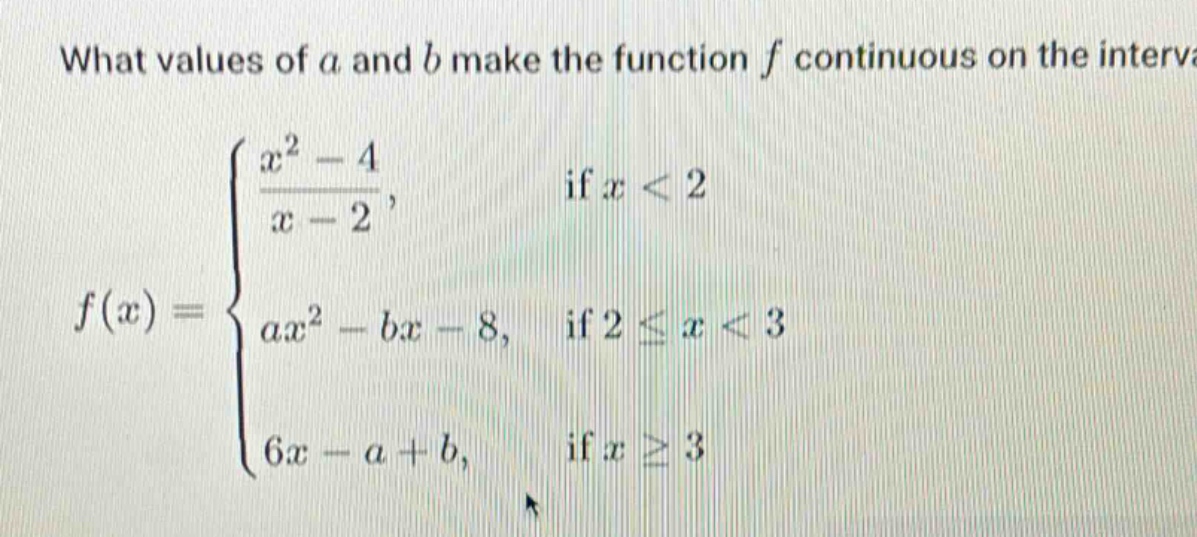
what values of a and b make the function f continuous on the interval\nf(x)=\begin{cases}\frac{x^{2}-4}{x - 2},& \text{if }x<2\\ax^{2}-bx - 8,& \text{if }2leq x<3\\6x - a + b,& \text{if }xgeq3end{cases}
Answer
Explanation:
Step1: Simplify the first - part function
For (x < 2), (f(x)=\frac{x^{2}-4}{x - 2}=\frac{(x + 2)(x - 2)}{x - 2}=x + 2) (for (x\neq2)). The limit as (x\to2^{-}) is (\lim_{x\to2^{-}}f(x)=\lim_{x\to2^{-}}(x + 2)=4).
Step2: Calculate the left - hand and right - hand limits at (x = 2)
For (2\leq x<3), (f(x)=ax^{2}-bx - 8). The left - hand limit as (x\to2^{-}) is 4, and the right - hand limit as (x\to2^{+}) is (4a-2b - 8). For continuity at (x = 2), we have (4a-2b-8 = 4), which simplifies to (4a-2b=12) or (2a - b=6) (Equation 1).
Step3: Calculate the left - hand and right - hand limits at (x = 3)
For (2\leq x<3), (f(x)=ax^{2}-bx - 8), so (\lim_{x\to3^{-}}f(x)=9a-3b - 8). For (x\geq3), (f(x)=6x - a + b), and (\lim_{x\to3^{+}}f(x)=18 - a + b). For continuity at (x = 3), we have (9a-3b-8=18 - a + b), which simplifies to (10a-4b=26) or (5a-2b = 13) (Equation 2).
Step4: Solve the system of equations
Subtract Equation 1 ((2a - b=6) or (b = 2a - 6)) from Equation 2. [ \begin{align*} 5a-2b-(2a - b)&=13 - 6\ 5a-2b-2a + b&=7\ 3a - b&=7 \end{align*} ] Substitute (b = 2a - 6) into (3a - b=7): [ \begin{align*} 3a-(2a - 6)&=7\ 3a-2a + 6&=7\ a&=1 \end{align*} ] Substitute (a = 1) into (b = 2a - 6), we get (b=2\times1 - 6=-4).
Answer:
(a = 1), (b=-4)